How Often Should a Disaster Recovery Plan Be Tested?
A disaster recovery plan is only effective if it works when you need it. Learn how often to test your plan, which exercises to run, and how to set up a consistent testing schedule.

A business can have automated backups, documented recovery procedures, and a designated IT team responsible for restoring critical systems. But what happens when the business actually needs to recover? Can the team restore essential applications within the expected timeframe? Are the backups usable? Do employees know their responsibilities?
You can't answer these questions by reviewing documentation alone. They require regular disaster recovery testing.
The financial consequences of an unsuccessful recovery can be substantial. According to IBM's report, the global average cost of a data breach reached a record $4.99 million, up 12% from the previous year. Business disruption and the costs associated with detecting and containing incidents contributed to the increase.
For small and mid-sized businesses, an extended outage can put customer relationships, revenue, and daily operations at risk. The Change Healthcare cyberattack demonstrated how a major technology disruption can affect healthcare operations, payment processes, and access to essential services. It reinforced the need to make disaster recovery a top priority for healthcare organizations.
This guide explains how frequently to test, what each exercise should cover, and how to build a practical testing calendar that keeps your business prepared.
Is Your Disaster Recovery Plan Ready for the Unexpected?
Find out whether your backups, recovery procedures, and IT infrastructure can support business continuity when disruption occurs.
What Is Disaster Recovery Testing?
An effective IT disaster recovery plan evaluates whether an organization's documented recovery procedures, backup systems, and assigned responsibilities can restore critical business operations after a disruption.
It helps determine whether the recovery strategy works under realistic conditions, not just whether it looks complete on paper.
Consider a business that experiences a server failure. Its IT team knows that daily backups are available and has documented the restoration procedure. However, during recovery, the team discovers the latest backup is incomplete, and an application depends on a server not included in the recovery documentation.
Each issue creates another delay.
Disaster recovery plan testing identifies these problems before an actual incident exposes them. Regular testing can help businesses address recovery weaknesses before they contribute to a costly data breach or prolonged operational disruption.
The objective is to verify that the organization can:
- Recover critical data from usable backup copies.
- Restore applications, servers, and infrastructure in the correct sequence.
- Meet established Recovery Time Objectives (RTOs) and Recovery Point Objectives (RPOs).
- Coordinate recovery responsibilities across internal teams and external providers.
- Maintain appropriate security controls during restoration.
- Resume business operations without introducing additional risks.
An effective testing program evaluates both the technical recovery process and the people responsible for executing it.
How Often Should a Disaster Recovery Plan Be Tested?
No single testing frequency applies to every business. The right schedule depends on the criticality of business systems, recovery requirements, security exposure, and any applicable regulatory obligations.
However, organizations can use a combination of annual, quarterly, monthly, and event-driven testing to maintain recovery readiness.
CISA's guidance identifies annual testing as generally sufficient for most services, while quarterly or monthly exercises may be appropriate for particularly critical services or environments that change frequently.
Annual Testing: Conduct a Comprehensive Recovery Exercise
Every business should establish a comprehensive annual disaster recovery exercise as a baseline.
This exercise should evaluate the overall recovery strategy, including documentation, personnel responsibilities, critical system dependencies, backup availability, and restoration procedures.
Depending on the business environment, annual testing may involve:
- A complete review of recovery documentation and contact information.
- A tabletop exercise involving business and IT decision-makers.
- Restoration of selected critical applications and databases.
- Validation of recovery infrastructure and alternate environments.
- Evaluation of actual recovery times against established RTOs and RPOs.
- Documentation of findings and corrective actions.
An annual exercise provides an opportunity to evaluate whether the entire recovery framework remains aligned with business requirements.
However, waiting until the end of the year to discover that a backup cannot be restored is not a sensible approach. Annual comprehensive testing should be supported by more frequent technical checks.
Quarterly Testing: Validate Critical Recovery Capabilities
Quarterly disaster recovery testing is particularly useful for businesses that depend on applications, servers, databases, or cloud infrastructure that cannot remain unavailable for extended periods.
These exercises can focus on specific recovery scenarios instead of testing the entire environment each time.
Quarterly exercises may also include tabletop simulations involving ransomware, extended cloud outages, server failures, or compromised credentials.
Businesses should also use these exercises to evaluate their ransomware recovery plan, including how quickly they can isolate affected systems, identify clean recovery points, and restore critical operations.
Monthly Testing: Verify Backup and Restoration Readiness
Monthly testing should focus on the reliability of backup and restoration capabilities.
This does not mean conducting a complete disaster recovery simulation every month. Instead, businesses can select critical systems or recovery points and verify that the data restores successfully.
Monthly activities may include:
- Restoring selected files, databases, or application components.
- Checking backup completion reports and failed jobs.
- Verifying backup integrity and accessibility.
- Reviewing backup retention and storage capacity.
- Confirming access permissions and recovery credentials.
- Checking whether protected recovery copies remain available.
For businesses with frequently changing databases or critical cloud workloads, some backup verification activities may need to happen more frequently than once a month.
Event-Driven Testing: Reassess Recovery After Significant Changes
A fixed calendar is not enough to maintain recovery readiness.
Businesses should also conduct targeted disaster recovery plan testing after changes that could affect their ability to restore systems.
These include:
- Major infrastructure upgrades or migrations.
- Introduction of new critical applications.
- Changes to cloud platforms or backup providers.
- Significant network security or identity architecture changes.
- Changes to recovery personnel or third-party service providers.
- A cybersecurity incident or failed recovery attempt.
- Updates to RTOs, RPOs, or business continuity requirements.
The frequency should therefore be driven by both the testing calendar and changes in the business environment.
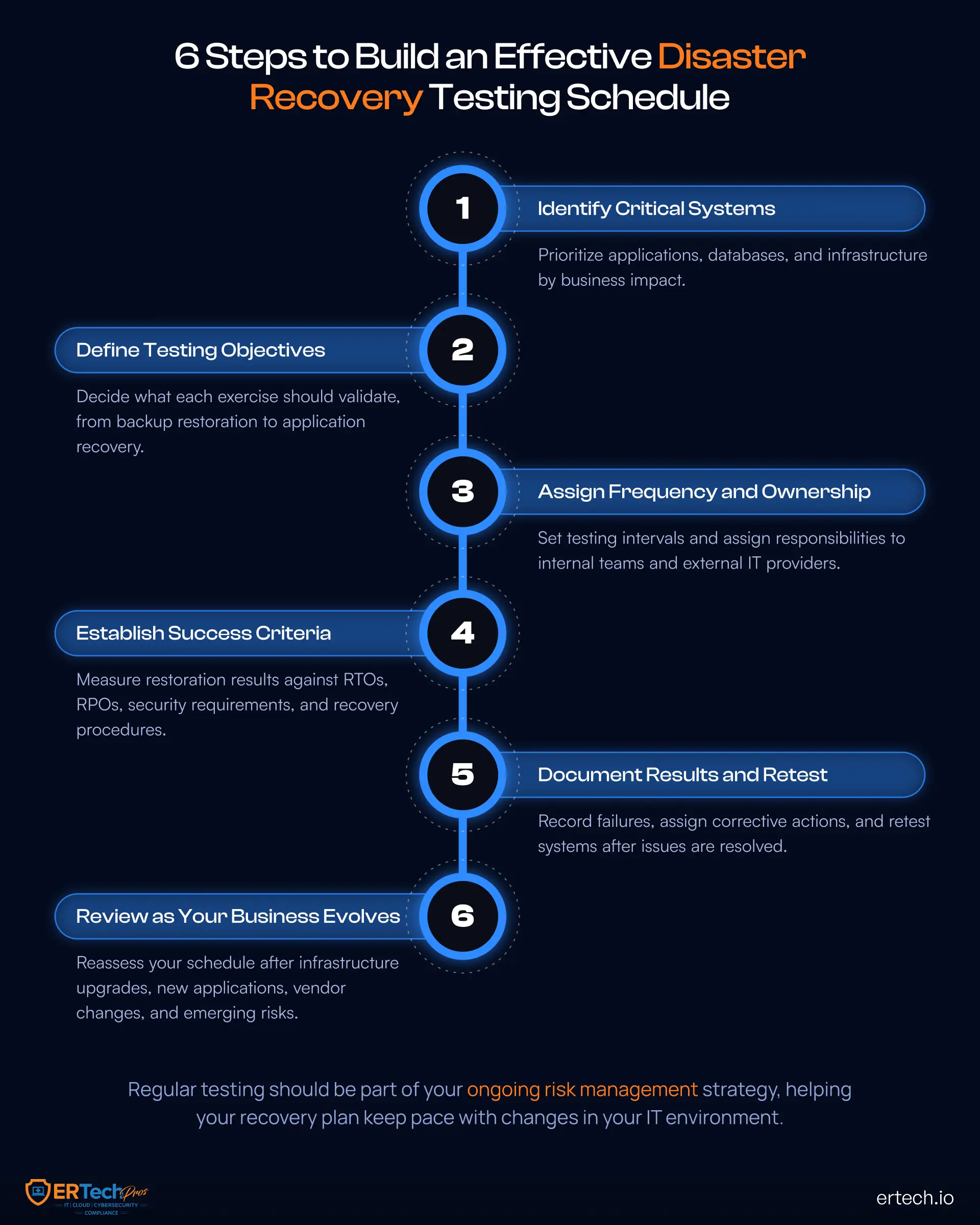
Types of Disaster Recovery Tests Businesses Should Conduct
Not every disaster recovery test needs to involve restoring an entire production environment. Different testing methods evaluate different aspects of recovery readiness.
A balanced incident response checklist should combine documentation reviews, simulated scenarios, and technical restoration exercises.
Tabletop Exercises: Test Decision-Making and Communication
A tabletop exercise brings together the people responsible for recovery and walks them through a simulated disruption.
Participants discuss who activates the recovery plan, which systems to isolate, who contacts the backup provider, and which applications to restore first.
Tabletop exercises are particularly useful for identifying unclear responsibilities, missing contact details, communication delays, and gaps in recovery documentation.
Walk-Through Tests: Review Recovery Procedures Step by Step
A walk-through test involves reviewing the documented recovery procedures in greater detail.
Participants follow the instructions they would use during an actual incident and determine whether each step is clear, complete, and executable.
This can reveal outdated instructions, missing credentials, incorrect system references, or dependencies that were overlooked during planning.
Walk-through testing is also useful when onboarding new recovery personnel or reviewing changes to the IT environment.
Functional Tests: Validate Individual Recovery Capabilities
Functional tests evaluate whether specific components of the recovery strategy work as intended.
A business might test whether its backup platform can restore a database, whether a recovery server can support an application, or whether employees can access systems through an alternate connection.
These exercises involve actual technical activities without necessarily transferring the entire production workload.
Parallel Tests: Run Recovery Systems Alongside Production
A parallel test activates recovery infrastructure while primary production systems continue operating.
The organization can verify whether the alternate environment can support critical applications, process transactions, or perform essential business functions.
Since the primary environment remains operational, parallel testing provides a more realistic technical assessment without immediately transferring all production activity.
Full-Scale Tests: Simulate a Complete Recovery
A full-scale disaster recovery test is the most extensive form of testing.
It simulates a major disruption and involves activating the recovery strategy, restoring systems, coordinating personnel, and validating business operations.
Depending on the test design, this may involve switching workloads to an alternate environment or temporarily transferring operations away from primary infrastructure.
Full-scale testing requires careful planning because it can affect production services. Businesses should establish clear test boundaries, rollback procedures, authorization requirements, and communication protocols before conducting one.
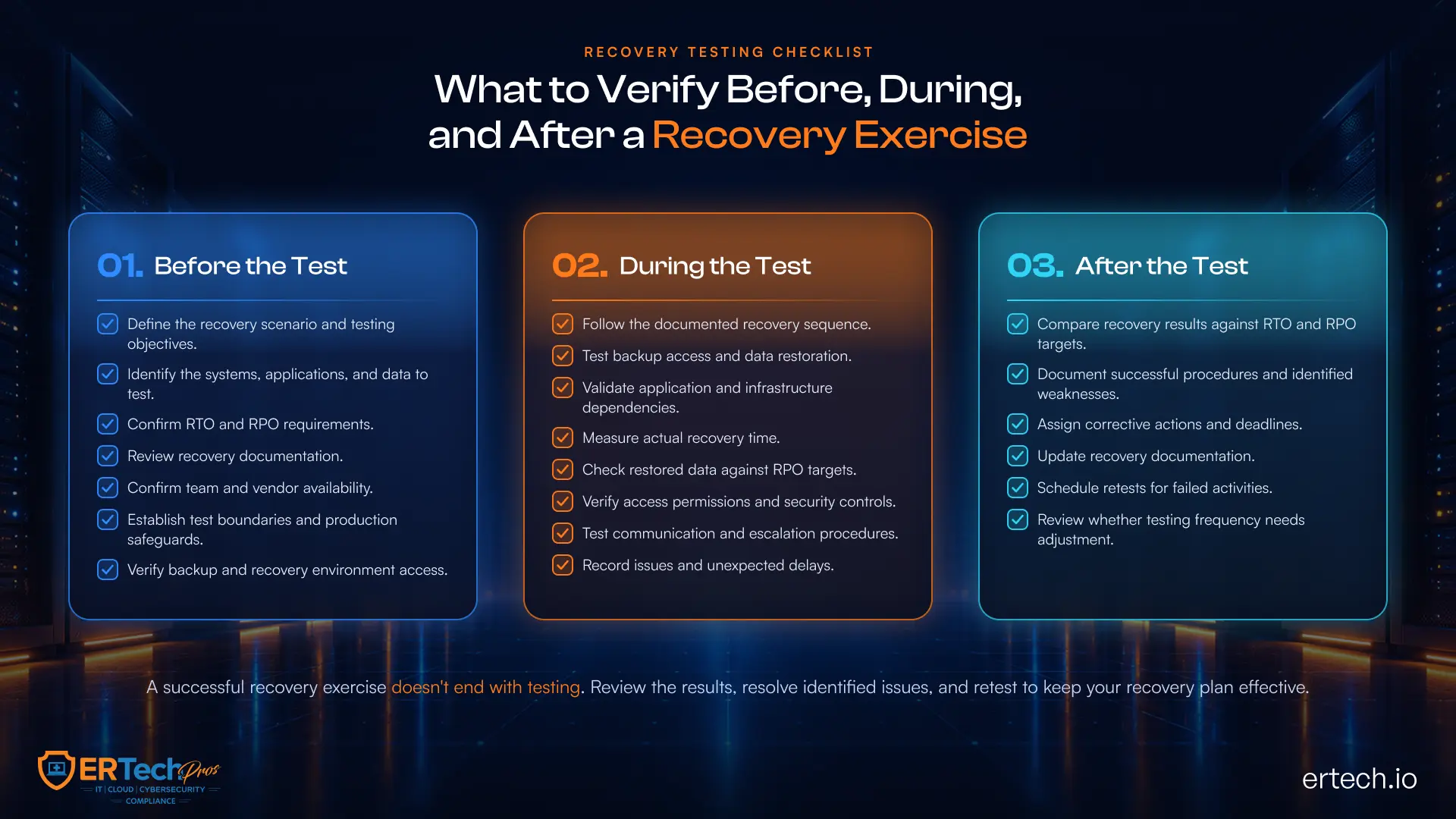
Disaster Recovery Plan Checklist
Businesses should understand how their service providers' control reports relate to their operational and security requirements, including SOC 1 vs. SOC 2 compliance.
Keep Your Disaster Recovery Plan Ready With ER Tech Pros
A disaster recovery plan should evolve alongside the business it protects. New infrastructure, changing applications, increasing data volumes, and emerging cybersecurity threats can all affect how quickly an organization can restore operations.
ER Tech Pros helps businesses maintain the infrastructure, monitoring, backup, and cybersecurity capabilities that support effective recovery.
Our approach includes:
- Backup and Recovery Management: Support for protecting critical business data and maintaining recovery capabilities.
- Cloud and Infrastructure Management: Management of business-critical infrastructure and cloud environments that support operational continuity.
- 24/7 NOC and SOC Monitoring: Continuous infrastructure and security monitoring to help identify issues that could affect system availability or recovery.
- Endpoint Detection and Response (EDR): Detect and investigate suspicious endpoint activity that could compromise production or recovery environments.
- Recovery Readiness and Validation: Technical oversight to help assess recovery capabilities and identify issues that need attention.
- Managed IT Services: Ongoing support for infrastructure, security, and operational requirements as the business environment changes.
Businesses evaluating the right level of IT support can also consider managed vs. co-managed IT models to determine how recovery responsibilities, infrastructure management, and technical oversight should be shared.
For organizations that need additional technical oversight, ER Tech Pros can support recovery planning and related IT operations through a managed services approach.
Our objective is to help businesses maintain reliable systems, protected data, and recovery capabilities that are aligned with their operational requirements.
A Disaster Recovery Plan Is Only Ready When It Has Been Tested
A documented recovery plan provides direction, but regular testing confirms whether the business can actually follow it.
The right disaster recovery testing schedule combines monthly backup restoration checks, quarterly exercises, annual comprehensive testing, and additional validation after significant infrastructure or operational changes.
Each exercise should produce measurable results. Can you restore critical applications within their RTOs? Does recovered data meet RPO requirements? Are recovery responsibilities clear? Can the business resume operations without compromising security?
Consistently answering these questions helps organizations identify weaknesses while they still have time to fix them.
Don't Let Recovery Gaps Catch You Off Guard!
Make disaster recovery testing a recurring part of how your business manages its IT environment.
Got Questions?
We've Got Answers
Find clear answers to common questions that help guide your IT operations.
Related Content

Zero Trust Security for Small and Mid-Sized Businesses: A Practical Guide

Managed IT Services vs. Co-Managed IT: Which Is Right for Your Business?