
How to Develop a Ransomware Recovery Plan & Prevent an Attack
A ransomware attack can disrupt systems long after the initial compromise. Learn how to develop a ransomware recovery plan that protects critical data, validates backups, and gives your business a structured path to recovery.

It is 8:17 on a Monday morning. Employees cannot open shared files. A critical server is showing unusual activity. Then the ransom note appears.
The first instinct may be to restore from backup. But ransomware recovery is rarely that simple. If the attacker has compromised credentials, moved through the network, altered systems, or reached the backup environment, restoring the wrong system from the wrong recovery point can bring the problem back.
The recovery challenge is significant. IBM found that 99% of organizations affected by successful ransomware attacks lost data, while 45% recovered only half or less. That means backups alone don't guarantee a reliable path to recovery.
That is why a ransomware recovery plan cannot begin after systems go down. It needs to be designed while the business is still operating, with clear recovery priorities, protected backups, defined responsibilities, and a process for determining when systems are safe to restore. A ransomware incident response checklist can also help teams work through the critical actions that precede recovery.
This guide explains how to build a ransomware disaster recovery plan, prepare for ransomware attack recovery, protect critical data, and reduce the chances that an attack becomes a prolonged business disruption.
Know where your recovery plan stands before an attack does.
Why Your Business Needs a Ransomware Recovery Plan Before an Attack
Imagine the same Monday morning scenario without a documented plan.
The IT team knows backups exist, but nobody knows which backup is clean. Security wants to investigate first. Operations wants email and business applications back online. Everyone is working, but nobody is following the same sequence.
This is where recovery can stall.
A disaster recovery plan for ransomware creates that sequence before incident pressure arrives. It establishes recovery priorities and decision-making authority while the environment is still operating normally.
Recovery Objectives Define What "Back to Normal" Means
Two measurements are particularly important:
Recovery Time Objective (RTO) defines how quickly a system needs to be restored.
Recovery Point Objective (RPO) defines how much recent data the organization can afford to lose.
For example, an internal reporting application might tolerate several hours of downtime, while a core business application may need restoration within an hour. Similarly, losing 24 hours of reporting data may be acceptable for one system but unacceptable for a transaction database.
A ransomware disaster recovery plan should document these priorities instead of treating every system as equally urgent.
How a Ransomware Recovery Plan Works From Attack to Restoration
A practical ransomware recovery plan follows a controlled progression rather than treating restoration as a single event.
The process generally moves through five stages:
Detect → Contain → Assess → Restore → Validate
The order matters.
If an organization begins restoring systems before verifying containment, it can bring compromised accounts, malware, or persistence mechanisms back into the environment.
Detect and Establish the Incident :
Recovery planning begins when suspicious activity becomes a confirmed security incident.
The response team should establish the detection time, identify affected systems, preserve relevant evidence, and determine whether the incident involves encryption, credential compromise, data theft, lateral movement, or multiple attack paths.
Understanding how ransomware works helps security teams recognize that encryption may be only one stage of a larger intrusion.
Contain the Attack :
Before recovery begins, the organization needs to restrict the attacker's ability to move through the environment.
That can involve isolating affected endpoints, disabling compromised accounts, terminating suspicious sessions, restricting network communication, and protecting backup infrastructure.
Document these actions in a ransomware response plan so the team can move quickly without losing sight of containment and recovery priorities.
Assess What Can Be Trusted :
Once the team contains the immediate threat, the recovery team needs to establish the scope of compromise.
This includes reviewing:
- Affected endpoints and servers
- Privileged accounts
- Authentication activity
- Backup infrastructure
- Critical applications
- Network connections
- Cloud resources
- Potentially exposed data
This assessment determines which systems can be recovered and which require remediation or rebuilding. If the incident has resulted in a data breach, the organization should also determine what information may have been accessed or exfiltrated.
Restore in Business Priority Order :
A recovery team should not restore everything simultaneously.
Critical identity services, network infrastructure, security controls, core applications, databases, and other dependencies may need to be restored in a defined sequence.
This is where the ransomware disaster recovery plan becomes an operational guide, not a document stored in a folder.
Validate Before Returning to Production :
Check a restored system for malicious activity, unexpected accounts, unauthorized configuration changes, suspicious processes, and other signs of compromise.
The recovery team should also confirm that security controls are active and that restored systems can communicate only with the infrastructure they are supposed to reach.
Only then should systems return to normal production operations.
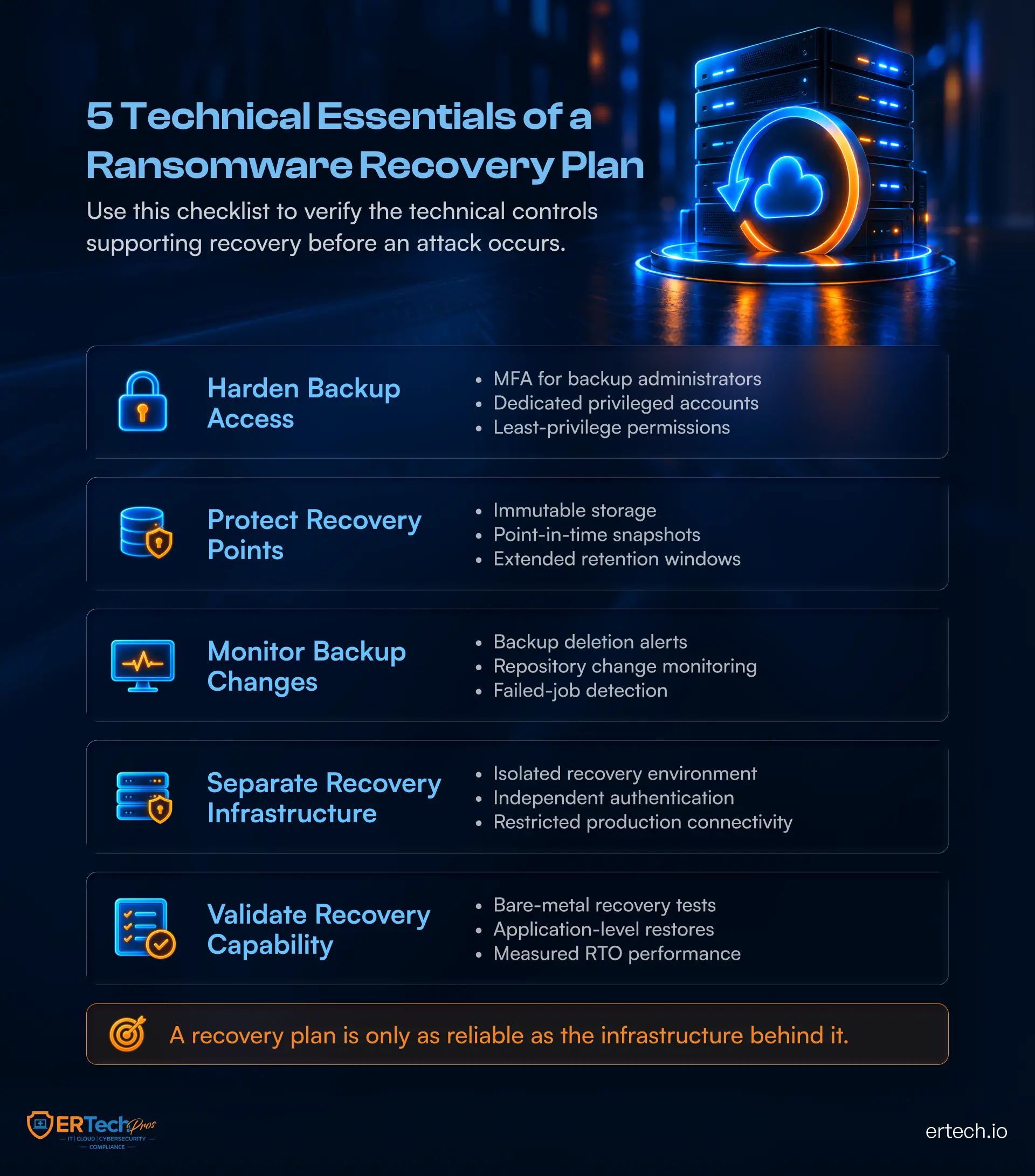
Prevent and Isolate Your Data From Ransomware Attacks With ER Tech Pros
The best ransomware recovery plan is one your organization hopes it never has to use.
ER Tech Pros takes a proactive approach to cybersecurity services designed to help businesses identify threats, restrict attacker movement, protect critical infrastructure, and maintain a path to recovery.
Our approach can support the security and recovery lifecycle through:
- 24/7 monitoring: We continuously monitor security events across endpoints, servers, identities, cloud environments, and network infrastructure.
- Endpoint containment: EDR capabilities help investigate malicious processes and isolate affected systems.
- Identity protection: Monitor privileged accounts, authentication patterns, remote-access activity, and potential credential misuse.
- Backup protection: Protect recovery infrastructure against unauthorized access and modification.
- Incident response: Established procedures help teams investigate credible threats and contain them quickly.
Businesses looking for ransomware attack protection can combine these capabilities with a tested recovery strategy to reduce the potential impact of an attack.
The goal is to give your business two layers of resilience: controls that make ransomware harder to execute and a recovery strategy that gives you a path forward if those controls are bypassed.
When Ransomware Hits, Your Recovery Plan Becomes the Business Plan
A ransomware attack can turn a normal business day into a recovery operation within minutes.
The organizations that recover with greater control are the ones that have already answered the difficult questions: Which systems matter most? Which backups can be trusted? Who can authorize recovery? How will compromised credentials be handled? What gets restored first? How will the team know the environment is safe?
A ransomware recovery plan turns those questions into documented decisions.
A ransomware disaster recovery plan takes that process further by connecting recovery objectives, protected backups, identity controls, infrastructure dependencies, restoration procedures, and validation into one framework.
The objective of ransomware attack recovery is not simply to get systems running again. It is to restore trusted operations without giving the attacker another opportunity to return.
If your business has experienced a breach, now is the time to determine whether your backups, infrastructure, and recovery procedures can actually support data recovery ransomware demands.
Your Recovery Plan Should Have Been Ready Yesterday
Know whether your backups, recovery infrastructure, and security controls can support a rapid, controlled recovery before an incident tests them.
Got Questions?
We've Got Answers
Find clear answers to common questions that help guide your IT operations.
Related Content
Ransomware Incident Response Checklist: What to Do in the First 60 Minutes

How to Build an Effective Ransomware Response Plan