How Does Ransomware Work? A Step-by-Step Guide for Businesses
Ransomware does not become a business crisis in a single step. This guide walks through the attack lifecycle and explains where organizations can detect, contain, and prevent ransomware.
It is 9:12 on a Tuesday morning. Rachel, an accounts manager at a mid-sized manufacturing company, receives an email that appears to come from one of the company's regular suppliers. The message asks her to review an updated invoice. Nothing seems unusual, so Rachel clicks the link and signs in using her work credentials.
She closes the browser and gets back to work.
What Rachel does not know is that her credentials have just given an attacker a potential way into the company's environment. From there, the attacker can begin exploring connected systems, looking for additional access, valuable data, and opportunities to move deeper into the network.
The threat is growing more organized. IBM's 2026 report found that active ransomware and extortion groups increased 49%, from 73 in 2024 to 109 in 2025.
That makes one question increasingly important for businesses: How does ransomware work, and where can an organization stop it before encryption and extortion begin?
Continue to read this blog, where we break down how a ransomware attack unfolds and how ER Tech Pros helps businesses strengthen protection across the attack lifecycle.
What Is Ransomware and What Does It Actually Do?
Ransomware is malicious software designed to disrupt access to files, systems, or data and pressure a victim into paying a ransom. But by the time a ransom note appears, an attacker may have already spent hours or days inside the environment.
That distinction matters.
For Rachel, the incident did not begin when her files became inaccessible. It began when her credentials were compromised. From that point, the attacker could potentially use her identity to understand the environment, identify valuable systems, and look for ways to expand access.
Modern ransomware operations can also involve data theft. Attackers may copy sensitive information before encrypting systems, creating a second source of pressure: even if the business can restore its files, the stolen data may still be used for extortion.
So, understanding how does ransomware work means looking at the entire intrusion, not just the moment files become encrypted.
How Does Ransomware Work? Following the Attack Lifecycle
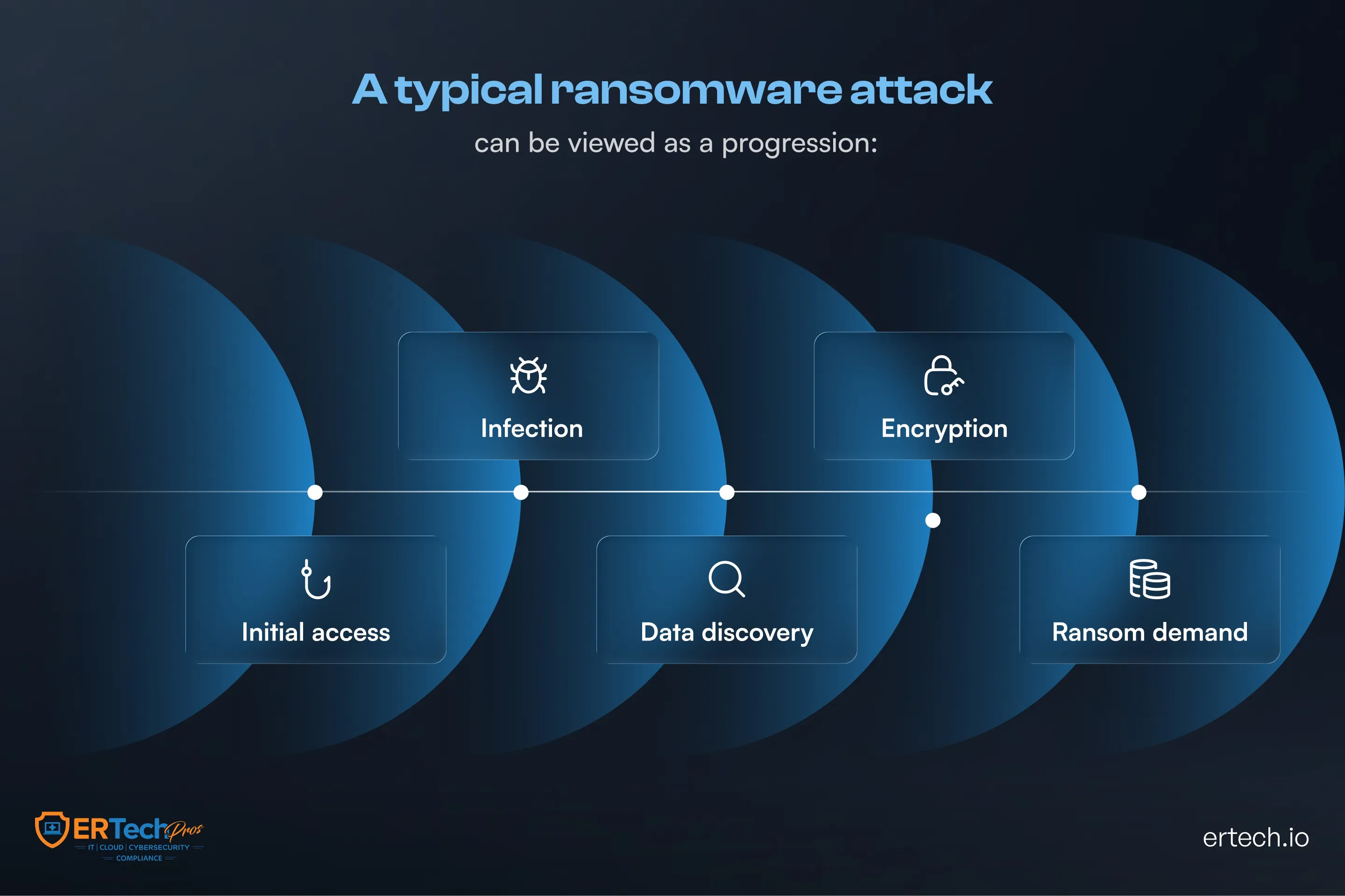
The exact sequence varies between attacks, but most ransomware incidents involve several stages. Each stage presents a different security challenge and, importantly, a different opportunity for detection.
1. Initial Access Creates the Entry Point
Every attack needs a way in.
Attackers may exploit an unpatched vulnerability, use stolen credentials, target exposed remote access services, or use a phishing email to persuade an employee to open a malicious attachment or follow a malicious link.
This first stage can be difficult to recognize because the activity may initially resemble legitimate user behavior.
For example, Rachel's compromised credentials give the attacker an identity they can potentially use to access company resources.
This initial access can happen through stolen credentials, exploited vulnerabilities, exposed remote services, or malicious content. The attacker does not necessarily need to compromise the entire network immediately. They first need a foothold.
Strong authentication can make that foothold harder to establish. MFA, conditional access policies, and controls around privileged accounts can limit what happens when credentials are exposed.
2. Infection
Once access is established, attackers may execute malware and establish a foothold within the environment while trying to maintain control and expand their access.
The compromised system may become the starting point for a much larger intrusion. Attackers can attempt to establish persistence, obtain additional credentials, elevate privileges, and identify systems that provide access to valuable data.
At this stage, there may still be no ransom demand and no obvious disruption.
That does not mean nothing is happening.
It means that Rachel can still open her applications, respond to emails, and complete her work. Nothing on her screen tells her that someone else may be interacting with the environment.
For the security team, however, unusual processes, authentication behavior, or endpoint activity may provide the first indication that something is wrong.
3. Data Discovery and Privilege Escalation
Rachel's account may not have access to the systems an attacker ultimately wants.
The attacker therefore looks for ways to obtain additional privileges. This could involve compromised administrator credentials, poorly controlled service accounts, excessive permissions, or weaknesses within the environment.
The more privileges an attacker gains, the more systems they can reach.
This is why access should be based on what a person or system actually needs to perform its function. Restricting unnecessary privileges can limit damage from a compromised account.
4. Lateral Movement Extends the Compromise
Now the attack begins lateral movement beyond Rachel's workstation.
The attacker may use legitimate credentials or available network connections to reach other endpoints, servers, shared resources, or applications. They are essentially learning how the business operates from inside its own environment.
This is where how ransomware spreads becomes particularly important.
A poorly segmented network can give attackers more routes between systems. Strong segmentation, endpoint monitoring, and tightly controlled administrative access can make those routes harder to use.
The objective is not simply to stop one infected computer. It is to prevent that computer from becoming a pathway to everything else.
5. The Ransom Demand
After disrupting access, attackers typically present a ransom demand explaining what happened and what they expect in exchange for restoring access or preventing the release of stolen information. If sensitive information has been removed from the environment, the incident can also become a data breach, creating additional legal, regulatory, financial, and reputational consequences for the organization.
At this point, the business is dealing with an active incident that can affect operations, customers, employees, finances, and reputation.
But the ransom note is not necessarily the first opportunity to respond.
The strongest defenses are designed to identify the attacker before the final stage.
How Does Ransomware Spread?
Ransomware can spread through several routes, and attackers often combine more than one technique during the same campaign.
In Rachel's case, the initial compromise began with her work credentials. But gaining access to one employee account does not necessarily mean the attacker can immediately reach the rest of the business. The next objective is finding pathways from that account to other users, devices, applications, and systems.
Compromised Credentials
Rachel's stolen credentials may allow the attacker to sign in as a legitimate user, making the activity harder to distinguish from normal business access.
From there, the attacker may attempt to access shared applications, discover additional accounts, or identify credentials with greater privileges.
MFA, strong identity controls, privileged access management, and regular access reviews can reduce the opportunity for compromised credentials to become a pathway into critical systems.
Vulnerable Systems
Unpatched software and exposed services can provide attackers with an opening into the environment.
A consistent vulnerability management process helps organizations identify and remediate weaknesses before attackers can exploit them.
Malicious Links and Attachments
Rachel's initial compromise also illustrates how social engineering can become an entry point for ransomware.
Attackers may use convincing messages to persuade employees to open an attachment, visit a malicious website, or enter credentials into a fraudulent login page. Once they gain access, that initial interaction can become the starting point for a much larger intrusion.
This is why technical controls and employee security practices need to work together. The objective is not simply to prevent Rachel from making one mistake; it is to ensure that one mistake does not give an attacker unrestricted access to the business.
What Are the Warning Signs of a Ransomware Attack?
The ransom note is obvious. The earlier warning signs are not.
When Rachel arrived at work the morning after her credentials were compromised, nothing on her screen suggested that an attacker was inside the company's environment. She could still access her usual applications and continue working. Behind the scenes, however, the attack could already be generating activity that security teams could investigate.
Organizations should watch for unusual behavior across accounts, endpoints, networks, and data, not just wait for files to become encrypted.
Unusual Account Activity
Unexpected logins, unfamiliar locations, unusual login times, new accounts, or sudden privilege changes can indicate compromised credentials.
Abnormal File Activity
Large numbers of files being modified, renamed, or accessed unexpectedly can indicate that encryption or data discovery is underway.
Security Tools Being Disabled
Attackers may attempt to disable security software, logging, backup services, or other controls that could expose or interrupt their activity.
Unexpected Administrative Activity
Unusual use of administrative accounts or remote management tools deserves investigation, particularly when the activity falls outside established business patterns.
Unusual Data Transfers
Large outbound transfers from systems that do not normally send substantial volumes of data can be an important warning sign, especially when sensitive repositories are involved.
Recognizing these ransomware attack signs early gives security teams a chance to isolate affected systems, disable compromised accounts, and interrupt the attack before it reaches more of the environment.
How to Protect Your Business From Ransomware
Rachel's experience shows why ransomware prevention cannot depend on a single security tool. Her compromised credentials created the initial opportunity, but the impact grew because an attacker could move beyond one account, reach additional systems, and eventually disrupt critical operations.
A resilient security strategy places controls at different points in the attack path so one compromised credential or device does not become a business-wide incident.
Strengthen Identity and Access Controls
The best way to prevent ransomware attacks is to make every stage of the attack harder to complete.
If an attacker obtains an employee's credentials, strong access controls can make those credentials less useful.
Organizations should implement:
- Multi-factor authentication for critical accounts and remote access
- Least-privilege permissions based on job responsibilities
- Regular reviews of user and service-account permissions
- Immediate removal of access when accounts are no longer required
Keep Systems Patched
A structured patch management process should cover operating systems, applications, firmware, remote access infrastructure, and other internet-facing systems.
Known vulnerabilities are much easier for attackers to exploit when organizations leave them unresolved.
Monitor Endpoints and Network Activity
Endpoint and network monitoring can help detect unusual processes, unauthorized changes, privilege escalation, suspicious connections, and abnormal data movement.
Segment Critical Systems
Network segmentation can limit how far an attacker can move after gaining access.
Critical servers, databases, administrative systems, and backup infrastructure should not be unnecessarily accessible from every employee endpoint.
The objective is to detect the intrusion before encryption becomes the most visible event.
Build Employee Security Awareness
Employees should understand how attackers manipulate urgency, trust, and routine business processes.
Regular training should teach employees how to identify suspicious requests, verify unexpected instructions, protect credentials, and report mistakes quickly.
Why Businesses Choose Managed IT Services for Ransomware Protection
Ransomware does not operate on a convenient schedule. An attacker can begin probing systems after business hours or start moving laterally before an internal team realizes something is wrong.
That makes continuous protection difficult for organizations with limited internal resources. Effective ransomware attack protection requires continuous visibility, timely detection, and coordinated response.
Managed IT services can provide ongoing monitoring, endpoint protection, vulnerability management, access control support, backup oversight, and incident response assistance without requiring a business to build every capability internally.
ER Tech Pros helps businesses strengthen these defenses with 24/7 security monitoring, cybersecurity services, endpoint protection, access controls, vulnerability management, and incident response support.
The objective is straightforward: reduce the opportunities attackers have to enter, move, and cause damage.
Stop the Attack Before the Ransom Note
Ransomware becomes most dangerous when an attacker has already gained enough access to disrupt the business.
But the attack does not have to reach that point.
Understanding how ransomware works gives organizations a clearer view of where those defenses belong.
The strongest ransomware strategy, therefore, isn't built around one product or one response. It is built around multiple layers that make the attack progressively harder to complete.
Don't Wait For a Ransom Note To Discover Security Gaps
Get a clear view of your current security posture and next steps.
Got Questions?
We've Got Answers
Find clear answers to common questions that help guide your IT operations.
Related Content

IT Disaster Recovery Plan for Small Businesses: A Complete Guide

Cybersecurity Awareness Month: 14 Security Steps Every Business Should Take in 2026