A Business Guide to Ransomware Protection and Recovery
A ransomware attack can start with a single click and escalate into a major business disruption. Read this blog to learn how modern ransomware attacks work, the risks they create, and the practical steps businesses can take to strengthen protection and recovery.
There is a version of ransomware that most people picture: a pop-up on a screen, a ransom note, systems locked. It looks dramatic. It looks obvious.
That is not how most ransomware attacks work anymore.
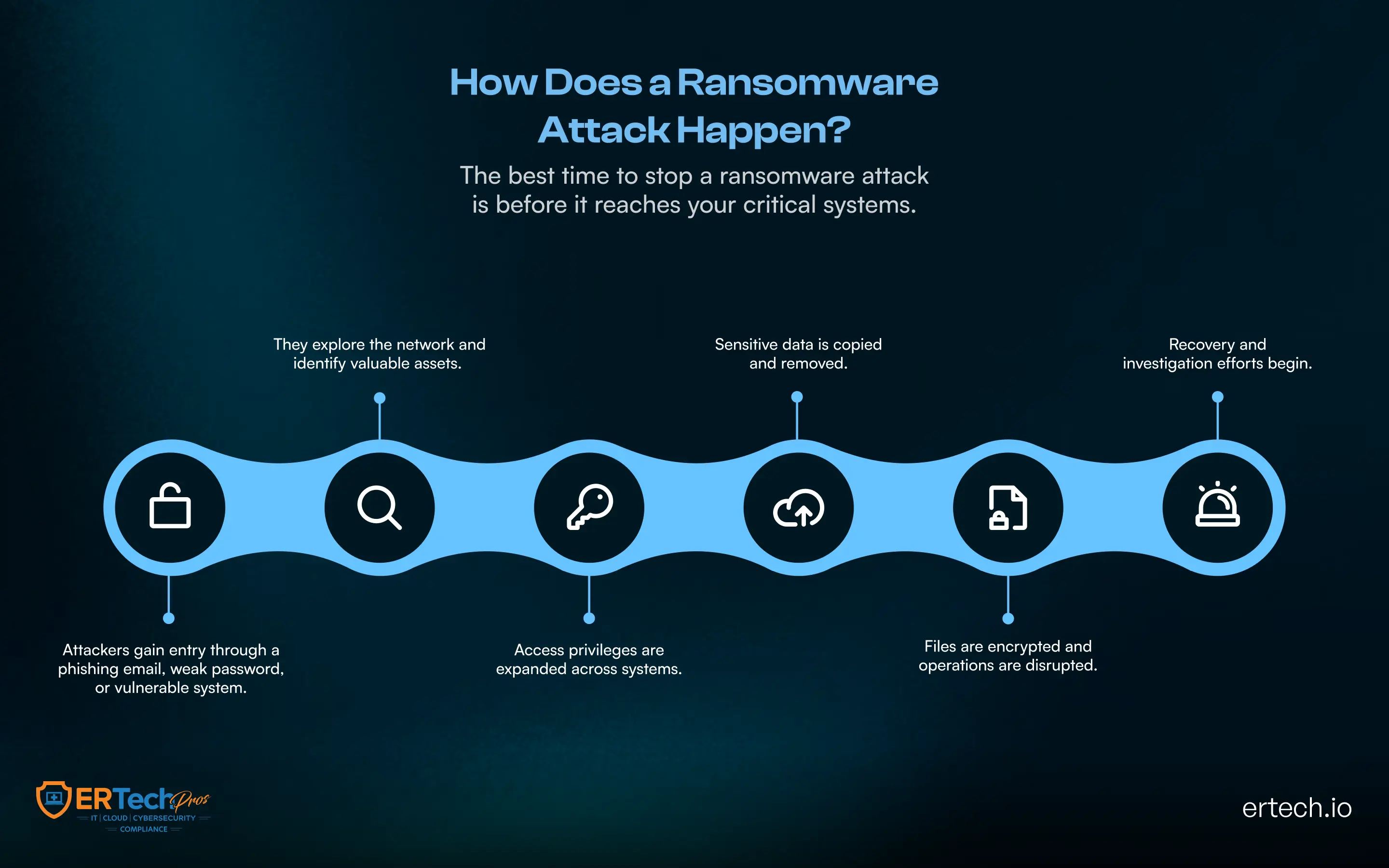
Today's attacks are quiet. Attackers get in through a phishing email, a weak password, or an unpatched system, and then they wait. By the time encryption starts, they have already mapped critical systems, escalated access, and in many cases copied sensitive data.
The financial damage reflects this. According to recent reports, the average ransomware-related incident costs businesses $4.4 million, factoring in downtime, recovery, legal exposure, and lost business.
This is why businesses are moving beyond basic security tools and building ransomware protection strategies to recover fast when something does go wrong.
At ER Tech Pros, we help organizations build and maintain business ransomware protection through continuous monitoring, endpoint security, employee awareness training, and proactive cybersecurity support designed for how modern businesses actually operate.
Is Your Business Prepared for a Ransomware Attack?
A single compromised device or phishing email can disrupt operations in minutes.
Why Ransomware Attacks Are Harder to Stop Today
A few years ago, a ransomware attack meant a locked screen and a restore from backup. Painful, but recoverable.
Today, the bigger problem is not the encryption; it is everything that happened before it. Modern ransomware groups use Ransomware-as-a-Service platforms, meaning even low-skilled attackers can deploy sophisticated malware at scale. They combine encryption with data theft, threatening to publish stolen information publicly if the ransom is not paid, a tactic known as double extortion.
And they increasingly target supply chains, using a trusted vendor's access to gain entry to larger organizations that would otherwise be difficult to breach directly. These are among the most common cybersecurity threats businesses face today, and the attack surface continues to grow.
What a Ransomware Breach Does to a Business
A ransomware breach is a people problem before it is a technical one.
Employees lose access to tools they depend on daily. Customers hit delays and outages. Leadership makes high-stakes calls without full information. For regulated industries like healthcare, financial services, legal, compliance reporting deadlines kick in immediately, regardless of how chaotic things are on the ground.
The reputational damage can outlast the technical recovery by months.
This is why business ransomware protection is no longer an IT department responsibility alone. It is a business continuity issue tied to operational stability, customer trust, and the organization's ability to keep functioning when things go wrong. The businesses that recover fastest are almost always the ones that were prepared before an attack happened.
Why Security Tools Alone Are Not a Strategy
Most businesses already have firewalls, antivirus software, spam filters, and backups. These are not nothing, but they are not a ransomware protection strategy.
Modern ransomware groups are specifically designed to move through the gaps between tools. Attacks succeed when multiple small vulnerabilities line up: a compromised account without MFA, an unmonitored endpoint, and backups connected to the same network as everything else.
Real ransomware protection focuses on layers working together: monitoring, detection, access controls, employee awareness, and response planning running as one continuous program rather than separate projects.
This is why strong cybersecurity strategies for businesses treat ransomware as part of a connected security program, not as a standalone problem to be solved with a single product.
How Phishing Keeps Driving Ransomware
Phishing is still one of the most reliable entry points for ransomware attackers because it targets people rather than systems. Modern phishing campaigns use AI-generated messaging, spoofed domains, fake invoices, and impersonated executives, communications timed to land when someone is moving fast and not paying close attention.
A single click can expose credentials or drop a malicious payload into the environment.
This is why email phishing attack prevention is one of the most direct investments in ransomware protection a business can make and why email security best practices matter. Technology filters out a lot. Informed employees catch what technology misses.
At ER Tech Pros, we help organizations build phishing resilience through advanced email filtering, simulated phishing exercises, and employee education that keep pace with evolving attack tactics.
Ransomware Prevention Best Practices
There is no single fix for ransomware. But there are controls that consistently make the difference between businesses that contain an incident quickly and those that spend weeks recovering from one. The following ransomware prevention best practices address the most common attack vectors and work best when they are maintained together rather than treated as one-time implementations.
Multi-Factor Authentication: Compromised credentials are one of the most common entry points. MFA makes stolen passwords far less useful across email, VPN, cloud platforms, and internal systems.
Endpoint Detection and Response: Standard antivirus looks for known threats. EDR monitors behavior like unusual file access, lateral movement, suspicious process execution, and flags attacks even when the malware variant is new.
Network Segmentation: Flat networks let ransomware spread without friction. Segmentation limits how far an attack can travel, so a compromised workstation cannot reach backup infrastructure or critical servers.
Patch Management: Unpatched vulnerabilities account for nearly a third of ransomware initial access methods. Delayed patches are not just an IT inconvenience; they are an open invitation.
Secure, Tested Backups: Modern ransomware groups target backup environments first. Backups need to be offline or immutable, stored separately from production systems, and tested regularly. An untested backup is not a safety net.
Zero Trust Access Controls: Zero-trust security verifies every access request continuously rather than trusting users or devices by default. This limits lateral movement after initial access, turning what could be a full-network encryption event into something containable.
Incident Response Planning: Organizations with tested response plans recover faster and at significantly lower cost. The plan should define who does what in the first hours after a ransomware breach is detected, how communications flow, and how recovery proceeds in order of priority.
How ER Tech Pros Protects Your Business From Ransomware
Building a ransomware program that holds up requires expertise and continuous attention across the full environment. For most businesses, it is not realistic to maintain in-house. ER Tech Pros provides fully managed ransomware protection and cybersecurity services that cover:
- 24/7 Security Operations Center: Continuous monitoring, threat detection, and incident response from analysts who know your environment
- AI-Powered Threat Detection: Behavioral monitoring that identifies ransomware activity even when the specific variant is new
- Endpoint Detection and Response: Full device fleet coverage, including remote and mobile endpoints
- Backup and Recovery Management: Immutable backups in isolated environments, tested against real recovery requirements
- Compliance-Aligned Programs: HIPAA-compliant infrastructure management and regulatory documentation for regulated industries
- Incident Response Planning: Documented plans and tabletop exercises that validate how the team actually performs under pressure
- Phishing and Awareness Training: Ongoing employee education that keeps pace with evolving attack tactics
The Right Time to Build Ransomware Protection Is Now
The businesses that handle ransomware attacks best decided to prepare before anything happened. A data breach that shuts operations down for three weeks and triggers a regulatory investigation does not get resolved by paying a ransom or rebuilding servers faster. The damage compounds in ways that take months to fully understand.
Effective ransomware protection means treating the risks of ransomware attacks the same way any serious business risk gets treated, with documented plans, clear ownership, and regular review. That is exactly how ER Tech Pros approaches it. We work with businesses to build ransomware programs that fit their environment, their industry, and their operational reality. Your business took years to build. The right ransomware program makes sure one incident does not define what comes next.
Don't Let a Ransomware Attack Catch Your Business Off Guard!
ER Tech Pros helps businesses identify security gaps and build layered ransomware protection before an attack happens.
Got Questions?
We've Got Answers
Find clear answers to common questions that help guide your IT operations.
Related Content
How to Build a Cybersecurity Incident Response Plan for Your Business

IT Disaster Recovery Plan for Small Businesses: A Complete Guide