How to Build an Effective Ransomware Response Plan
A ransomware attack can disrupt operations, compromise sensitive data, and expose critical security gaps. Learn how a ransomware response plan helps your business detect threats, contain intrusions, investigate compromises, recover safely, and strengthen ransomware resilience.
Ransomware is no longer a threat businesses can afford to treat as a rare IT emergency. IBM’s 2026 report found that active ransomware and extortion groups increased 49% in 2025, rising from 73 to 109 groups.
When an attack begins, the question is not whether your team knows what ransomware is. It is whether everyone knows what to do next.
Which systems should be isolated? Which accounts should be disabled? Who leads the response? Can your backups be trusted? And how do you restore operations without leaving the door open to the attacker?
A well-defined ransomware response plan answers those questions before an incident turns into a business-wide disruption. This guide walks through the critical steps businesses should take to detect, contain, investigate, recover from, and learn from a ransomware attack.
Don’t Wait for the Attack to Write Your Playbook
What Should a Ransomware Response Plan Cover?
A ransomware incident creates technical and business decisions at the same time. A response plan puts those decisions into a defined sequence, so teams aren't improvising while systems go offline.
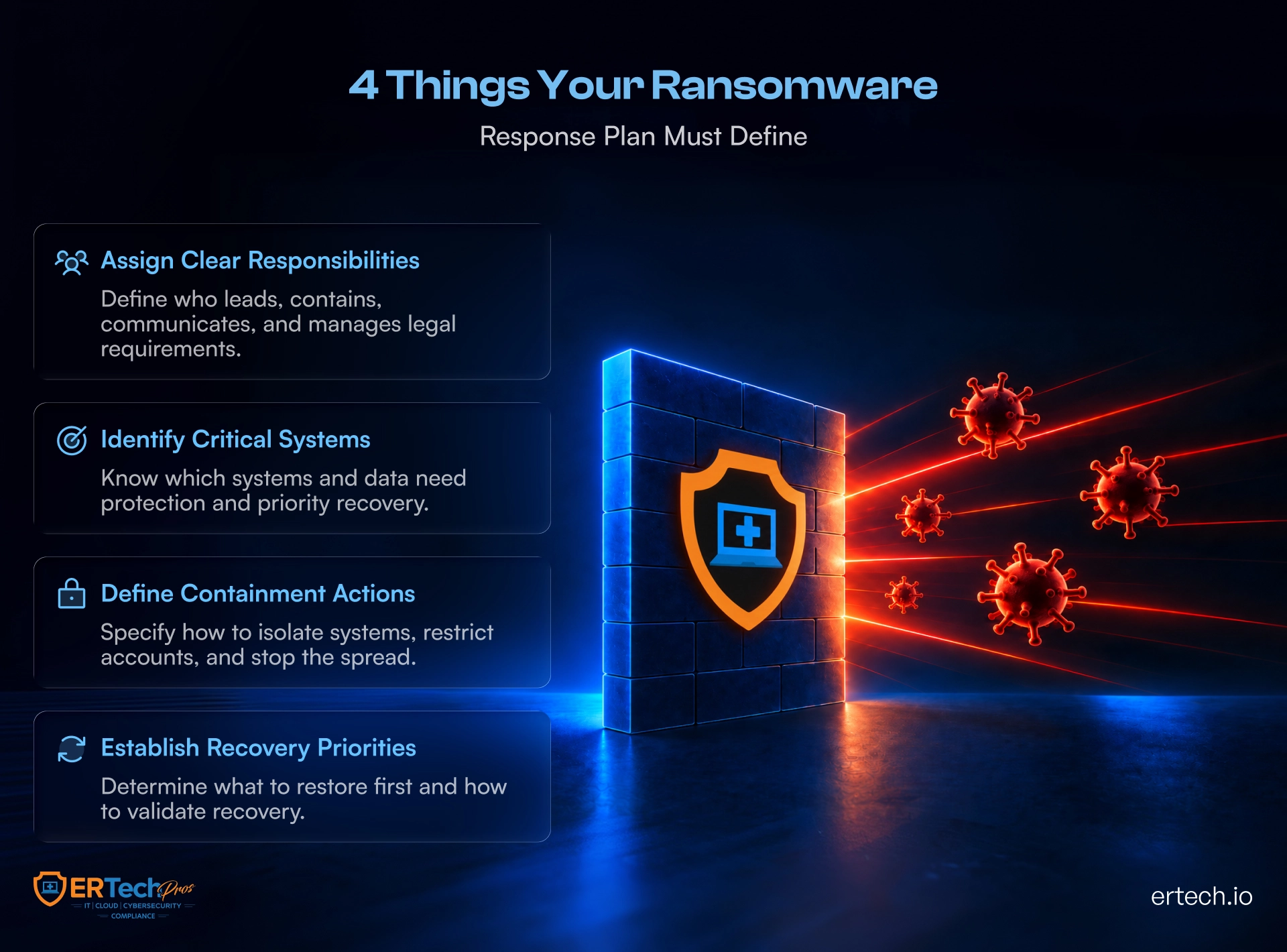
A practical ransomware incident response plan should establish who responds, what gets protected, how the attack is contained, and how operations are restored. CISA recommends that organizations maintain and regularly exercise an incident response and communications plan addressing ransomware and data-extortion incidents.
Detect the Attack and Activate the Response
Ransomware rarely arrives with a definitive diagnosis. The first indication may be unusual file activity, suspicious authentication, a security alert, or several users reporting inaccessible files.
Activate a ransomware response plan when available evidence reaches the organization's defined incident threshold, not after every detail is confirmed.
Security teams should examine endpoint telemetry alongside authentication records, VPN activity, administrative sessions, firewall logs, cloud activity, and file-access events.
A single suspicious process may be inconclusive. The same process combined with a privileged login and unexpected server connections may indicate an active intrusion.
This correlation helps establish whether the event is isolated or spreading.
Teams should also begin an incident timeline as soon as practical. Record when the first alert appeared, which systems were affected, what accounts were involved, and which response actions were taken.
That timeline can later help investigators identify the initial access point, reconstruct attacker activity, and determine where earlier detection may have been possible.
Contain the Intrusion and Limit Its Blast Radius
Once an attack is suspected, containment becomes the priority.
The objective is to restrict the attacker's ability to communicate with other systems while preserving enough evidence to understand the compromise. CISA's response guidance recommends identifying impacted systems and isolating them while taking care not to destroy useful evidence unnecessarily.
Three Steps to Contain a Ransomware Attack
- Isolate Affected Systems Segment or disconnect compromised endpoints, servers, and network zones to stop attacker communication.
- Revoke Compromised Access Disable affected accounts, terminate active sessions, and rotate compromised credentials.
- Block Lateral Movement Apply network segmentation and access controls to prevent attackers from reaching critical systems.
Coordinate containment rather than act indiscriminately. Compromised endpoints and servers may need to be disconnected from the network, while broader network-level controls may be necessary if multiple systems or subnets are affected.
Isolation alone is insufficient if stolen credentials remain active. Security teams should investigate suspicious user accounts, privileged accounts, service accounts, VPN sessions, and other authentication paths associated with the incident.
Immediately shutting down every machine can also destroy volatile evidence that may help determine how the intrusion occurred. The response must therefore balance rapid containment with evidence preservation.
Strong network security controls can further limit unnecessary connectivity and reduce the attack's blast radius.
Investigate the Compromise Before Recovery
Containment limits the immediate spread. Investigation determines how the attacker entered, what they accessed, and whether they moved across the environment.
Security teams should trace the initial access point, affected systems and identities, privilege escalation, lateral movement, persistence, and potential data exfiltration. This may involve reviewing authentication records, endpoint activity, remote-access sessions, network connections, and administrative actions.
Endpoint detection and response (EDR) can provide valuable telemetry to help reconstruct attacker activity across affected endpoints. Investigators should also examine file access, database activity, cloud-storage events, and network transfers to determine whether sensitive data was exfiltrated.
Recovery should proceed only after the organization has sufficient evidence to understand the compromise and address the access path that enabled it.
Preserve Evidence and Coordinate Communication
The pressure to rebuild systems can be intense, but rebuilding too early may destroy evidence needed to understand the incident.
Preserve relevant logs, system images, memory captures, endpoint telemetry, and other forensic artifacts where appropriate. CISA recommends collecting relevant logs and preserving volatile evidence during ransomware responses.
Communication should also remain controlled. Employees need clear instructions, leadership needs an accurate view of operational impact, and legal and compliance teams may need information to assess reporting obligations. Designated stakeholders should handle external communications based on verified findings.
This becomes especially important when an incident affects SOC compliance, contractual obligations, cyber insurance, or regulatory reporting.
Eradicate the Threat Before Restoring Systems
Recovery should not begin simply because the ransomware executable has been removed. The organization needs reasonable confidence that the attacker no longer has a pathway back into the environment.
This means removing persistence mechanisms, addressing compromised accounts, closing exploited vulnerabilities, and rebuilding systems when their integrity cannot be trusted.
Review access using a zero trust approach that limits access based on identity, device, resource, and business need. The response is incomplete if the same access path that enabled the intrusion remains open.
Verify the Environment Is Clean
Before moving to recovery, confirm that:
- Persistence mechanisms have been removed.
- You have addressed compromised credentials and accounts.
- Exploited vulnerabilities have been remediated.
- Rebuild or isolate systems you cannot trust.
- Security controls are functioning as expected.
Restore Operations From Trusted Recovery Points
Once eradication is sufficiently complete, begin recovery.
Validate backups for integrity, appropriate recovery points, and signs of compromise before restoration.
CISA recommends offline, encrypted backups and regular testing of backup availability and integrity because attackers may attempt to delete or encrypt accessible recovery data.
Organizations should also consider cloud ransomware protection across cloud storage and recovery environments, including access controls, logging, versioning, and appropriate separation from production resources.
Restore in Business Priority Order
Recovery should follow predefined priorities rather than simply restoring systems in the order they were affected.
- Restore critical infrastructure first.
- Bring back essential applications and their dependencies.
- Validate authentication, configurations, and security controls.
- Reconnect systems only after confirming their integrity.
A restored application is not useful if its authentication service, database, or underlying infrastructure remains unavailable. A ransomware response plan should therefore account for technical dependencies as well as business priorities.
Test the Response Before the Next Attack
A response plan is only valuable if people can execute it under pressure.
Organizations should test their incident response plan for ransomware through tabletop exercises, technical simulations, recovery testing, and communication drills.
Test the Decisions That Matter
Ask:
- Who receives the first alert?
- Who authorizes isolation?
- How quickly can compromised credentials be revoked?
- Which systems are restored first?
- Who communicates with employees and customers?
Testing can reveal outdated contact information, unclear authority, inaccessible backups, missing logs, and undocumented dependencies before an actual incident exposes them.
A tested ransomware incident response plan turns a document into an operational capability.
Strengthen Ransomware Resilience After Recovery
Recovery should end with a review of what happened and what needs to change.
Turn Lessons Into Security Improvements
Determine how the attacker entered, where detection succeeded or failed, which controls were bypassed, and how long containment and recovery took.
Review identity permissions, exposed services, endpoint visibility, segmentation, backup architecture, and employee reporting processes. Organizations that understand how ransomware works at each stage can better identify where security controls should interrupt the attack.
The objective is not to promise that ransomware will never happen. It is to make the next intrusion harder to execute, faster to detect, and more difficult to expand.
When Your Team Needs Additional Response Support
Building a ransomware defense that holds up requires expertise and continuous attention across the entire environment. For many businesses, maintaining that level of coverage entirely in-house is difficult. ER Tech Pros provides managed cybersecurity services designed to help businesses detect threats earlier, contain incidents faster, and strengthen their ability to recover.
Our approach includes:
- 24/7 Security Monitoring: Continuous monitoring and threat detection to identify suspicious activity, compromised accounts, unusual endpoint behavior, and emerging threats.
- AI-Powered Threat Detection: Behavioral analysis designed to identify anomalous activity and potential ransomware indicators beyond known attack signatures.
- Endpoint Detection and Response (EDR): Visibility across endpoints to detect suspicious processes, investigate activity, and support rapid response when a device is compromised.
- Vulnerability and Access Management: Identification of exploitable weaknesses, exposed services, excessive permissions, and compromised credentials that attackers can use to gain or expand access.
- Backup and Recovery Protection: Security-focused backup strategies and recovery planning designed to help protect critical data and support restoration when primary systems are disrupted.
- Incident Response Planning: Documented response procedures, defined responsibilities, and exercises that help teams make critical decisions under pressure.
- Security Awareness Training: Ongoing employee education focused on phishing, credential theft, social engineering, and other tactics commonly used to gain initial access.
The objective is not simply to deploy more security tools. It is to build a coordinated defense in which monitoring, endpoint security, identity controls, response procedures, and recovery capabilities work together.
If your organization has experienced a breach, restoring affected systems is only part of the response. Understanding how the attacker gained access, what controls failed, and what needs to change is essential to reducing the risk of another incident.
Is Your Business Prepared to Respond When Ransomware Strikes?
ER Tech Pros can help you identify gaps in your current defenses and build a stronger ransomware response strategy.
Got Questions?
We've Got Answers
Find clear answers to common questions that help guide your IT operations.
Related Content
How to Build a Cybersecurity Incident Response Plan for Your Business

IT Disaster Recovery Plan for Small Businesses: A Complete Guide