Unified Communications 101: How VoIP, Video, and Messaging Fit Together
Most businesses already use VoIP, video, and messaging. Few use them as one connected system. This guide explains what unified communications means and how to choose a setup built for the way your team really works.

Most businesses aren't short on communication tools. They have a phone system for customer calls, a video conferencing app for meetings, a messaging platform for team collaboration, and perhaps another tool for voicemail or file sharing. The problem is that these tools often operate independently, forcing employees to switch between applications and making communication more complicated than it needs to be.
Businesses are recognizing that communication works best when everything works together. According to reports, the global unified communications market was valued at USD 227.69 billion in 2026 and is projected to reach USD 897.95 billion by 2034, reflecting the growing demand for integrated communication platforms.
That's where unified communications solutions come in. By bringing VoIP, video conferencing, messaging, and collaboration tools together into a single platform, businesses can simplify communication, improve productivity, and create a better experience for both employees and customers.
In this guide, we'll explain how VoIP, video, and messaging fit together and what to look for when choosing the right solution for your business.
Stop Managing Multiple Communication Tools
What Is Unified Communications?
Unified communications, or UC, is exactly what it sounds like: a single platform that brings business calls, video meetings, instant messaging, voicemail, and collaboration tools together into one connected experience. Instead of switching between multiple applications throughout the day, employees can communicate, collaborate, and access information from a single system.
For years, this level of integration was largely associated with large enterprises and complex IT environments. Today, unified communications solutions have become far more accessible, allowing businesses of all sizes to simplify communication without investing in expensive on-premises infrastructure.
The reason UC matters now comes down to how people work. Teams collaborate across offices, homes, and mobile devices, while customers expect seamless communication regardless of how they choose to connect. When calls, meetings, and messages exist in separate systems, conversations become fragmented, productivity slows, and valuable information can easily be overlooked.
Many businesses begin this journey by modernizing their phone systems. If you're still evaluating internet-based calling, our top benefits of switching to VoIP explain why VoIP has become the foundation of modern business communication. Unified communications builds on that foundation by bringing voice, video, and messaging together into one connected platform.
How VoIP, Video, and Messaging Work Together in a Unified Communications System
Think about a typical customer interaction. A prospect calls your sales team with a question, the conversation moves to a video meeting for a product demonstration, and follow-up details are shared through instant messaging. If each of these interactions happens on a different platform, employees have to switch between applications, search for previous conversations, and manually piece everything together.
A unified communications platform eliminates those barriers by unifying all communication channels into a single, seamless experience.
VoIP Connects Every Business Conversation
Voice communication remains at the heart of business operations, whether it's answering customer inquiries, supporting clients, or collaborating with colleagues. VoIP unified communications uses your internet connection to deliver reliable business calling while offering advanced features like call routing, auto attendants, voicemail-to-email, and mobile access.
Behind the scenes, technologies such as SIP trunking enable VoIP systems to connect with the public telephone network without relying on traditional phone lines, giving businesses greater flexibility and scalability.
Video Creates More Meaningful Interactions
Some conversations are simply better face-to-face. Video meetings allow teams to collaborate more effectively, present ideas to clients, conduct training sessions, and resolve issues faster.
Instead of launching a separate application, employees can move from a phone call to a video meeting within the same platform, keeping the conversation and context intact.
Messaging Keeps Collaboration Moving
Not every discussion requires a call or a meeting. Instant messaging enables employees to ask quick questions, share updates, and resolve issues without interrupting their workflow.
Because messaging is integrated with voice and video, conversations remain connected. Employees can easily reference previous calls, meeting notes, and shared files, making collaboration faster and more organized.
Together, these communication channels create a connected experience where employees spend less time managing technology and more time serving customers and working together effectively.
The Benefits of Unified Communications for a Growing Business
The true value of unified communications goes beyond simply combining multiple communication tools into a single platform. It helps businesses communicate more efficiently, improve collaboration, and create a better experience for both employees and customers. Some of the biggest benefits of unified communications include:
Improved Team Collaboration
When voice calls, video meetings, and messaging work together, employees can collaborate without constantly switching between applications. Conversations remain connected, making it easier to share information, resolve issues quickly, and keep projects moving forward.
Better Customer Experiences
Customers expect seamless interactions, regardless of how they contact your business. With unified communications for business, employees can access previous conversations and communication history, enabling them to provide faster, more personalized support without asking customers to repeat information.
Greater Flexibility for Hybrid Work
Whether employees are working from the office, home, or on the road, they can access the same communication tools and stay connected across devices. This flexibility supports hybrid work while ensuring consistent communication across the organization.
Increased Productivity
Managing multiple communication platforms often means switching between applications, searching for information, and duplicating work. A unified platform simplifies daily workflows, helping employees spend more time on meaningful work and less time managing technology.
Easier Scalability
As your business grows, your communication system should grow with it. Unified communications makes it easier to add users, support new locations, and introduce additional collaboration capabilities without the complexity of managing separate communication systems.
Cloud Unified Communications vs. Traditional Setups
Not all unified communications solutions are built the same way, and where a system runs makes a real difference.
Why the Cloud Changed the Equation
Cloud unified communications runs entirely over the internet, without the on-site servers or bulky hardware that older systems depended on. That matters for a few reasons. There's no equipment to maintain, no technician visit every time something needs an update, and no ceiling on how many users or locations the system can support.
Cloud-based unified communications also makes remote and hybrid work genuinely seamless. Since the system isn't tied to a physical office, employees can log in from anywhere and have full access to their calls, messages, and video meetings, exactly as if they were sitting at a desk in headquarters.
What This Looks Like for Larger Organizations
The scalability of cloud infrastructure is also why unified communications for enterprise has grown so quickly. Larger organizations need a system that can support hundreds or thousands of users, multiple departments, and often multiple locations, all without losing consistency across the business. Cloud infrastructure handles that kind of scale in a way traditional, hardware-based systems never could.
For a small or mid-sized business, the same principle applies at a smaller scale. You get enterprise-grade flexibility without needing an enterprise-sized IT team to manage it.
How to Choose the Right Unified Communications Provider
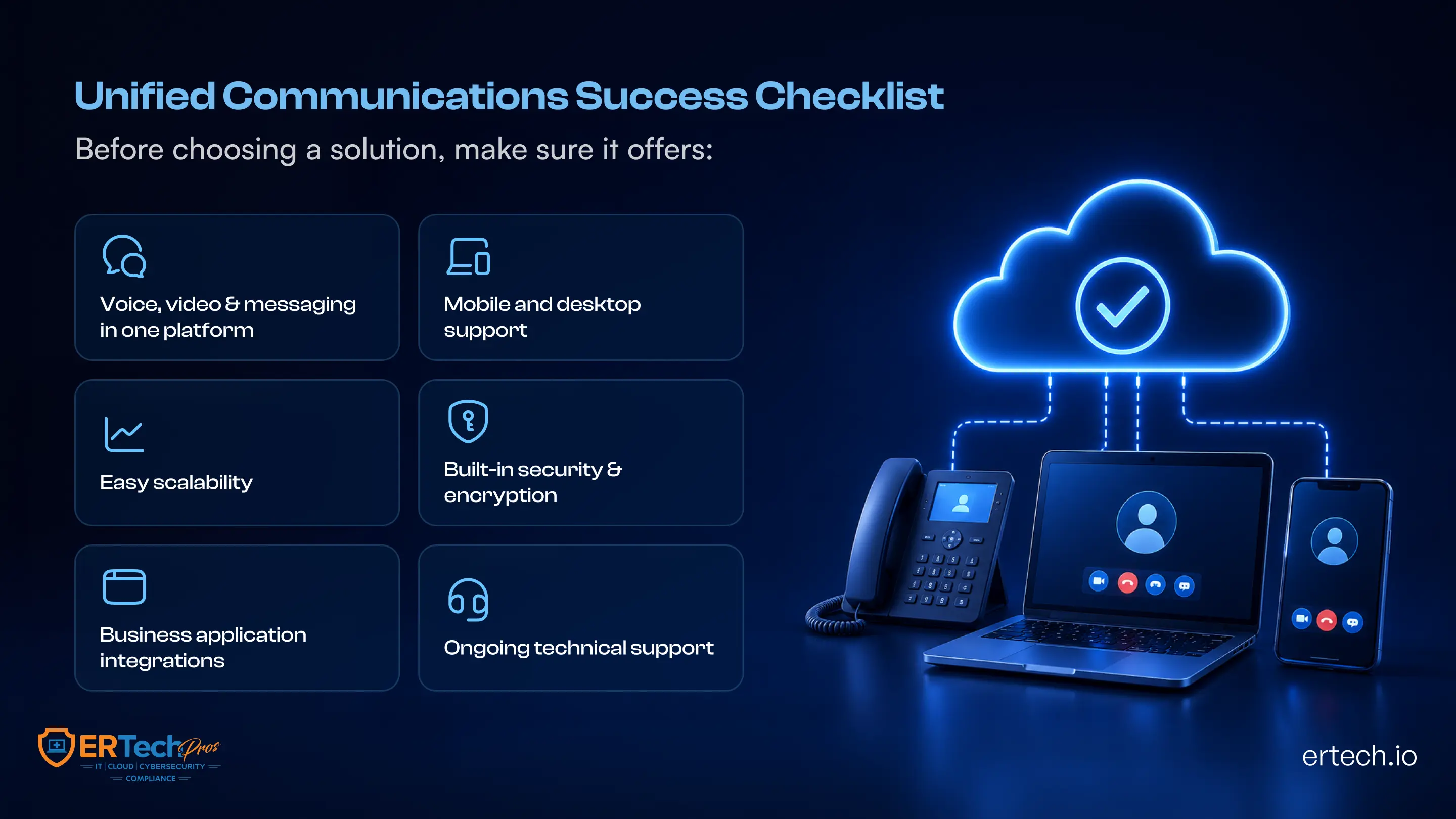
Choosing a unified communications platform isn't just about comparing features. The right provider should understand how your business communicates, recommend a solution that fits your workflows, and continue supporting you long after the system goes live.
Here's what to look for when evaluating unified communications providers and how ER Tech Pros helps businesses every step of the way.
A Solution Built Around Your Business
Every business communicates differently. Instead of offering a one-size-fits-all deployment, the right provider should take the time to understand your existing workflows, communication challenges, and long-term goals.
At ER Tech Pros, every implementation begins with a consultation to evaluate how your teams communicate today and identify opportunities to simplify collaboration.
Reliable Performance Starts with Your Network
Even the best communication platform depends on a reliable network. Before deployment, your provider should assess your infrastructure to ensure it can consistently support voice and video traffic.
ER Tech Pros evaluates bandwidth, latency, and quality of service (QoS) settings to help deliver clear calls, reliable video meetings, and a better overall communication experience.
Flexible Solutions That Grow with You
As your business grows, your communication platform should grow with it. Whether you're adding users, opening new locations, or modernizing your phone system with technologies like SIP trunking, your provider should make expansion simple, not disruptive.
Support Beyond Implementation
Deploying a unified communications platform is only the beginning. Ongoing monitoring, software updates, user training, and technical support all play an important role in ensuring long-term success.
That's why businesses choose ER Tech Pros. Our managed VoIP and unified communications services don't end after installation; we continue to support, optimize, and evolve your communication environment as your business grows.
Whether you're upgrading from a traditional phone system or looking to bring your voice, video, and messaging together, choosing the right partner can make all the difference.
Bring Your Business Communications Together
Business communication has evolved beyond phone calls. Today, employees collaborate through voice, video, messaging, and file sharing, often across multiple locations and devices. Managing these conversations through separate platforms can create unnecessary complexity, slow response times, and make collaboration harder than it needs to be.
Unified communications solutions bring these channels together into one connected platform, helping businesses improve collaboration, enhance customer experiences, and adapt to the changing way people work. Whether you're supporting a remote workforce, opening new locations, or simply looking for a more efficient way to communicate, the right solution can make a lasting impact on your business.
If you're beginning your communication modernization journey, our detailed guide on switching to VoIP is a great place to start. And when you're ready to bring your voice, video, and messaging together, ER Tech Pros can help you design, deploy, and support a unified communications solution that fits your business today and scales with you tomorrow.
Ready for a More Connected Workplace?
Let ER Tech Pros help you bring calls, meetings, and messaging together into one reliable, easy-to-manage platform.
Got Questions?
We've Got Answers
Find clear answers to common questions that help guide your IT operations.
Related Content

Medusa Ransomware: What Businesses Can Learn From the Attack

How to Develop a Ransomware Recovery Plan & Prevent an Attack