Making the Switch to VoIP: A Detailed Guide for Modern Business Communication
Switching from traditional phone systems to VoIP can transform how healthcare organizations communicate. This guide explains how to move to VoIP, what to prepare for, and how ER Tech Pros simplifies the transition with secure, scalable solutions built for modern healthcare workflows.

If your healthcare organization relies on a traditional phone system, you must have noticed the limitations. The rising costs, lack of mobility, constant maintenance, and the outdated features make the day-to-day communication frustrating, especially in a setting where timely coordination directly impacts patient health.
This is why so many healthcare organizations are moving to VoIP phone systems: a modern, flexible, cost-effective way to communicate in a world where clinical and administrative teams are often spread across facilities, remote locations, and on-call environments.
Voice over Internet Protocol (VoIP) assists you in calling anyone using an internet connection instead of old copper phone lines. This means that you can use a VoIP phone, your laptop, your mobile device, or even an app to stay connected from anywhere. It’s the evolution of healthcare communication, giving practices the reliability, mobility, and efficiency they need to support both staff and patients.
Continue to read this blog to know why VoIP phone service is growing rapidly across healthcare and how you can prepare your organization for this transition.
Plus, discover how ER Tech Pros can make sure that your switch is smooth, compliant, and aligned with your clinical workflow.
Why More Healthcare Organizations Are Adopting VoIP
Healthcare environments depend on fast, accurate, uninterrupted communication. Whether it’s scheduling, coordinating referrals, reaching on-call staff, or communicating with pharmacies and labs, your phone system must keep up, not slow you down.
That’s one of the major reasons organizations are shifting to VoIP phone service. It’s a practical transition towards flexibility, scalability, and smoother day-to-day operations!.
Lower Costs Without Sacrificing Reliability
According to the HIPAA Journal, VoIP system significantly reduces operational costs for healthcare organizations by eliminating the need for costly on-site hardware, maintenance, and traditional phone line infrastructure.
Built to Scale as Your Organization Expands
Scalability matters to any organization. Therefore, as your staff grows or you expand to newer locations, a VoIP system should grow with you – without requiring technicians, cable installations, and delays.
Work From Anywhere
Flexibility is another benefit. Healthcare teams, front desk staff, care coordinators, providers, remote employees, and after-hours teams can easily make VoIP calls from anywhere. With cloud-based voice over IP phone service, your team stays connected using mobile devices, desktop computers, or physical VoIP phones, ensuring continuity whether they’re in the clinic, on the go, or working from home.
Smarter Features That Support Daily Workflows
Features included in today’s VoIP services are leaps ahead of old phone systems. Healthcare organizations benefit from call routing, call recording, auto attendants, voicemail-to-email, and analytics.
With ER Tech Pros guiding your setup, you get a customized system designed for your workflow, not a generic one-size-fits-all setup!
Assessing Your Current Phone Setup
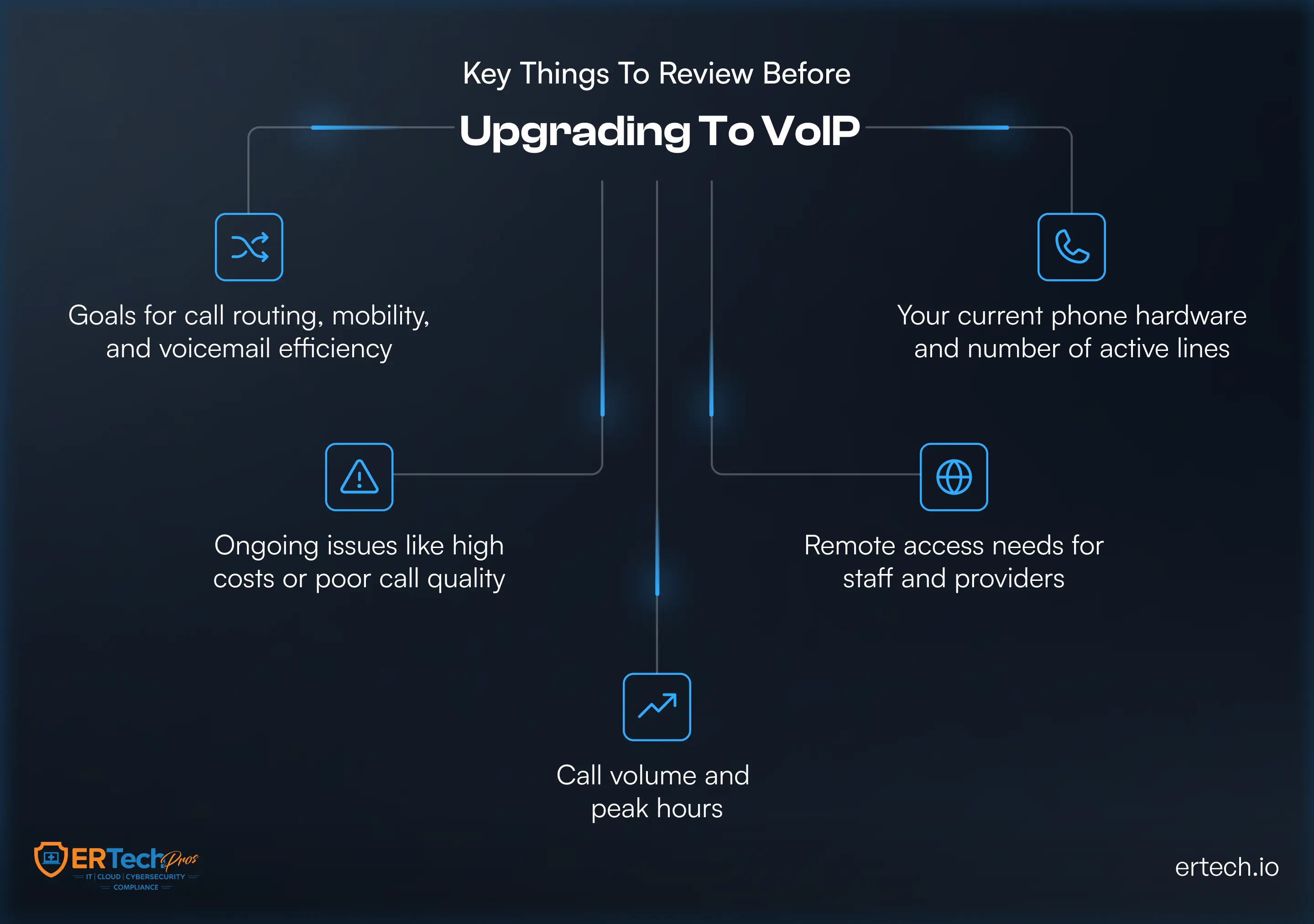
Before you make the decision to move to a new VoIP telephone service, it’s important to know the current communication system your healthcare organization relies on. Many practices only evaluate their phone systems when there’s an outage or performance issue, but a proactive assessment ensures a smoother transition.
The first step is to review your current hardware, phone lines, call volume, and the number of users who rely on your system daily. This helps in determining the ideal VoIP telephone solution for your environment.
Next, consider the challenges you're going through. Are you struggling with high bills? Outdated hardware? Poor call quality? Limited access? Lack of integration with your scheduling system? These inconveniences make your goals for moving to voice over IP clear.
This is also the perfect time to identify what improved communication would look like. Perhaps you want better mobility for providers, upgraded call routing for patient scheduling, or more efficient voicemail management. ER Tech Pros uses these goals to design a customized VoIP phone system that supports your operational and clinical needs.
Preparing For The Transition To VoIP
Once your goals are clear, the next step is getting your organization ready for VoIP. Since VoIP runs on your internet connection, a little preparation goes a long way in ensuring smooth, reliable communication from the very first day.
Gauge Network Readiness
Since the quality of the call depends on the network, ER Tech Pros starts with a detailed review of bandwidth, network performance, and the quality of service settings. This prevents dropped calls, delays, or poor audio once VoIP is live.
Choose The Right VoIP Model
Cloud VoIP systems are generally the best fit for healthcare because they’re flexible, secure, and scalable, allowing your system to grow effortlessly as your organization expands.
Plan For Number Porting
Switching to VoIP doesn’t mean losing your existing phone numbers. Fortunately, you can almost always keep your current business numbers when switching to a voice IP phone service.
Set A Clear Budget
VoIP is cost-effective overall, but there may be a few initial expenses like new VoIP phones, headsets, router upgrades, or minor network adjustments. We help you create a clear, manageable budget so you know exactly what to expect.
Choosing The Right VoIP Provider
All VoIP phone plans offer different features and choosing the wrong one can negatively impact patient experience. ER Tech Pros evaluates based on uptime, call quality, platform stability, and ability to integrate with healthcare systems like your patient scheduling software or secure messaging tools.
Reliability is especially important for healthcare organizations. Missed/dropped calls can severely impact the patient care, billing, appointment scheduling, and emergency communication. That’s why ER Tech Pros offers solutions with proven performance records and strong service-level agreements.
Additionally, integrations also matter! For example, if your billing division has a Customer Relationship Manager (CRM) or your front office uses automated reminders, choosing a VoIP business solution that brings everything together guarantees a refined workflow.
Cost is also an important factor! Different VoIP providers charge in different ways - per user, per feature, or packaged plans. But, with ER Tech Pros you choose a system that suits your needs without overpaying for features you will never use.
Implementing VoIP And Training Your Team
Once you’ve chosen the provider and your network is ready, the process of implementation begins. ER Tech Pros makes this process efficient and stress-free by rolling out the system in phases, often beginning with a small pilot group. This lets your team get comfortable with all the features while our experts improve your call quality and system configuration.
In addition to a well-configured system, training is especially important in healthcare, where the staff manages a high volume of calls, appointment schedules, and handles patient communications.
ER Tech Pros provides a hands-on training session that guides your team through the new system, from handling voicemail to managing call queues and using mobile apps for after-hours coverage.
We also organize the system to support your clinical workflows, ensuring providers, nurses, coordinators, and administrators can all communicate successfully. We establish support channels, so your team always knows where to turn with questions or issues.
Post-Migration Optimization And Growth
Once your new system is live, healthcare communication becomes much easier, but optimization doesn’t stop there. ER Tech Pros continues to monitor call performance, user feedback, and any areas where your workflow might benefit from additional adjustments.
With regular software updates to your VoIP telephone, security patches, and improved features, your communication system stays modern, efficient, and secure. As your organization grows, ER Tech Pros helps implement additional tools such as AI call routing, improved analytics, and new integrations.
Common Mistakes To Avoid During A VoIP Transition
Most communication issues arise from ignoring the important steps. Some healthcare organizations underestimate their internet connection requirements, which results in poor call quality. Whereas a few organizations forget about security, VoIP requires encryption, secure protocols, and proper configurations to protect patient details.
Also, user training is often a common oversight. Staff members need to understand new features in order to fully benefit from them. And in case of an internet outage, every healthcare organization needs a backup communication plan. ER Tech Pros sets up failover strategies to ensure calls can still reach your team even during temporary disruptions.
Your Next Step Toward A Smarter Phone System
Switching to VoIP phone systems is more than a modernization effort; it’s a strategic upgrade that enhances the way your healthcare organization communicates. With better flexibility, reduced costs, improved scalability, and powerful communication tools, a VoIP phone solution supports efficient operations and strengthens patient communication.
With ER Tech Pros guiding your transition, you gain a partner who knows your clinical environment, your goals, and your need for reliable communication. Whether your organization is small, mid-sized, or multi-location, VoIP provides a smarter, secure, and a more connected future.
If you’re ready to explore VoIP for your healthcare organization, get in touch with ER Tech Pros today for a complete VoIP assessment.
Got Questions?
We've Got Answers
Find clear answers to common questions that help guide your IT operations.
Related Content

Cybersecurity Awareness Month: 14 Security Steps Every Business Should Take in 2026

Medusa Ransomware: What Businesses Can Learn From the Attack