Why Retail Businesses Are Prime Targets for Cyberattacks
Retail businesses face a threat landscape few other industries deal with at this scale. This guide explains why, and how integrated retail security can change the outcome.
A single cyberattack can bring a retail business to a standstill. A compromised point-of-sale (POS) system can interrupt sales. Stolen customer data can trigger regulatory scrutiny. Most importantly, a breach can damage the trust retailers spend years building.
That risk is growing. Cyberattacks against supply chains have increased fourfold over the past five years, according to IBM's 2026 X-Force Threat Intelligence Index. As retailers rely on interconnected POS systems, e-commerce platforms, payment processors, inventory software, and third-party vendors, every new connection expands the potential attack surface.
This is why retail cybersecurity has become a business priority, not just an IT responsibility. Today's retail cyber attacks don't stop at payment terminals. They target employee credentials, cloud applications, customer databases, and vendor networks to gain access to valuable information.
In this guide, we'll explore why retailers remain one of the most attractive targets for cybercriminals. You'll also learn about the biggest retail cybersecurity challenges businesses face today and practical strategies to protect customer data, strengthen operations, and preserve customer trust.
Build a Stronger Retail Cybersecurity Strategy with ER Tech Pros
The Digital Footprint That Makes Retail Vulnerable
Every industry has data worth stealing. Retail, however, offers a unique combination of high transaction volumes, valuable customer information, and fast-moving operations. Many retailers also operate with limited cybersecurity resources compared to the size of the digital environment they manage. Together, these factors make cybersecurity for retail an ongoing challenge.
Every Retail Transaction Creates Valuable Data
Retail runs on the constant exchange of information. Every purchase processes payment details. Every loyalty program signup creates a customer record. Every online order connects names, addresses, contact information, and transaction history across multiple systems.
For cybercriminals, that continuous flow of data presents countless opportunities. They don't need to compromise the entire network. Access to a single vulnerable system may be enough to steal sensitive information or establish a foothold for a larger attack.
Modern Retail Environments Create More Entry Points
Today's retail businesses depend on much more than POS terminals. E-commerce platforms, inventory management systems, payment processors, customer loyalty programs, cloud applications, and third-party vendors all work together to deliver a seamless shopping experience.
While these technologies improve efficiency, they also expand the attack surface. Every connected application, employee account, and vendor integration becomes another potential entry point. If one system is compromised, attackers may move laterally across the network until they reach payment systems or customer databases.
This growing complexity is one of the biggest reasons cybersecurity in retail requires a proactive, layered approach rather than isolated security tools.
Inside the Retail Attack Surface: Why POS Systems and Customer Data Are Primary Targets
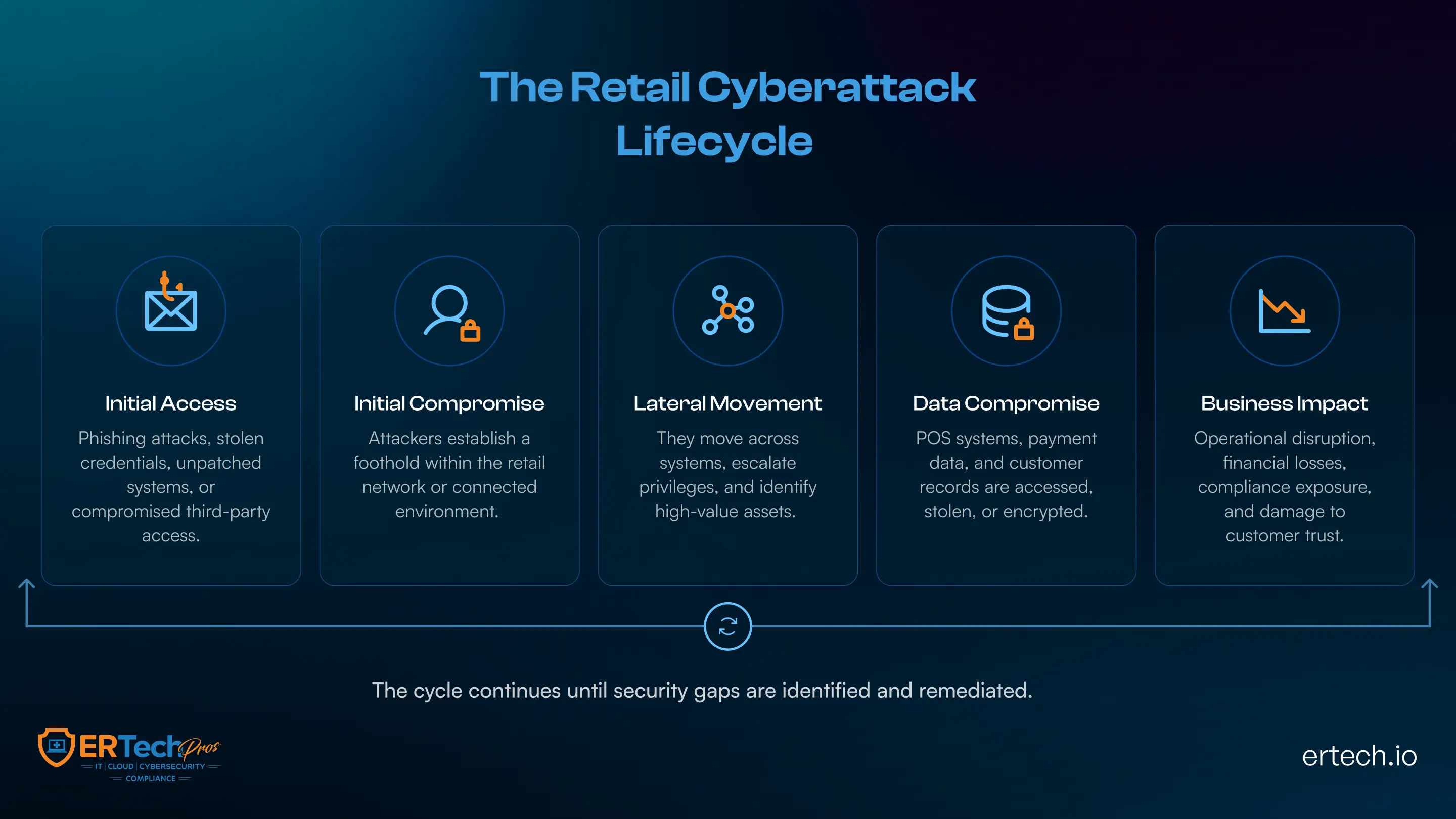
Every stage of the retail cyberattack lifecycle ultimately leads to one objective: access to high-value systems and sensitive information. For most retailers, that means point-of-sale (POS) systems and customer data. Together, they power daily operations while storing and processing information that cybercriminals can monetize, making them some of the most attractive targets in retail cybersecurity.
Why POS Systems Remain a High-Value Target
Point-of-sale systems do far more than process payments. They connect with inventory management platforms, payment processors, customer loyalty programs, and back-office applications to keep retail operations running smoothly. Because these systems sit at the center of every transaction, they often become one of the first targets in retail cyberattacks.
Attackers look for vulnerabilities such as unpatched POS software, weak administrative credentials, or insecure remote access. Once a POS system is compromised, it can be used to capture payment card information, provide access to connected systems, or serve as a gateway into the wider retail network. Protecting these systems requires regular patching, network segmentation, strong access controls, and continuous monitoring.
Customer Data Is a High-Value Asset
Payment card information isn't the only asset attackers are after. Customer names, email addresses, phone numbers, purchase histories, and loyalty program details have become equally valuable because they can be used for identity theft, phishing campaigns, and account takeover attacks.
For retailers, the impact goes far beyond the immediate incident. A compromised customer database can trigger regulatory obligations, increase recovery costs, and significantly damage customer confidence. Looking back at some of the biggest data breaches in the USA shows how quickly a single security incident can escalate. The result is often financial loss, legal challenges, and long-term reputational damage. As retailers continue expanding digital and omnichannel experiences, strengthening cybersecurity in retail means protecting customer information wherever it is collected, stored, or shared.
The Biggest Retail Cybersecurity Challenges Businesses Face Today
Strong security isn't just about deploying the latest technology. Retailers operate in fast-paced environments where customer experience, operational efficiency, and cybersecurity must work together. Balancing these priorities is what makes retail cybersecurity challenges so complex.
Expanding Digital Operations Increases Risk
Modern retail extends far beyond the physical store. E-commerce platforms, mobile applications, self-checkout systems, cloud services, and connected inventory management solutions all improve the customer experience. However, every new technology, integration, or connected device also expands the attack surface.
Without consistent visibility across these systems, identifying vulnerabilities before attackers do becomes increasingly difficult.
Third-Party Vendors Can Introduce Hidden Risks
Retailers depend on payment processors, logistics providers, software vendors, and cloud service providers to keep daily operations running. While these partnerships improve efficiency, they also create additional points of exposure.
If a trusted vendor experiences a security incident or has weak access controls, attackers may use that connection to reach the retailer's environment. Regular vendor risk assessments and least-privilege access help reduce this risk.
Human Error Remains a Leading Cause of Breaches
Technology alone cannot prevent every attack. Employees interact with payment systems, customer information, and business applications every day, making them an important part of any security strategy.
Phishing emails, weak passwords, and accidental data exposure continue to contribute to successful cyber incidents. Regular security awareness training helps employees recognize suspicious activity and how to report phishing emails before potential threats spread across the organization.
Limited Resources Make Prioritization Essential
Large retail chains often have dedicated security teams, but many independent retailers operate with limited IT resources and smaller budgets. This makes cybersecurity for small retailers especially challenging, as they face many of the same threats without the same level of expertise or technology.
Rather than trying to implement every security solution at once, retailers should focus first on high-impact controls such as multi-factor authentication, timely patch management, endpoint protection, and continuous monitoring. Keeping up with the biggest cybersecurity threats and how to prevent them also helps retailers strengthen their defenses as the threat landscape evolves.
Building a Stronger Retail Cybersecurity Strategy with ER Tech Pros
Protecting a retail business requires more than deploying individual security tools. It requires a layered security strategy built on core cybersecurity principles to protect POS systems, e-commerce platforms, employee devices, and customer data. ER Tech Pros helps retailers strengthen every layer of their security posture with proactive monitoring, advanced threat detection, and continuous risk management.
24/7 Security Operations Center (SOC) Monitoring
Cyber threats don't stop after business hours. Our security operations center (SOC) provides continuous monitoring to detect suspicious activity across your retail environment. By identifying unusual behavior early, we help contain threats before they disrupt business operations or compromise sensitive customer information.
Endpoint Detection and Response (EDR) & AI-Powered Threat Detection
POS terminals, employee workstations, servers, and mobile devices all represent potential attack surfaces. We deploy EDR alongside AI-powered threat detection to identify malicious activity and investigate suspicious behavior across connected endpoints.
This enables faster incident detection and response before threats can spread. As AI becomes a larger part of modern security operations, retailers should also understand the risks and solutions in AI integration for cybersecurity. Doing so helps them balance automation with effective risk management.
Vulnerability Management & Patch Management
Unpatched software remains one of the most common entry points for attackers. ER Tech Pros performs regular vulnerability assessments, prioritizes remediation based on risk, and helps ensure that operating systems, POS software, and business-critical applications remain up to date against known exploits.
Identity & Access Management (IAM)
Compromised credentials continue to fuel many successful retail cyberattacks. We strengthen access security through multi-factor authentication (MFA), role-based access control (RBAC), and least-privilege policies to reduce unauthorized access and limit lateral movement across the retail network.
Data Protection, Backup & Disaster Recovery
Protecting customer information requires more than preventing attacks. We implement encrypted backups, disaster recovery solutions, and recovery testing to help retailers restore critical systems quickly and minimize operational disruption following a cyber incident.
Employee Security Awareness & Incident Response Planning
Employees remain one of the first lines of defense. We provide ongoing cybersecurity awareness training to help staff identify phishing attempts and other social engineering tactics. We also develop and test incident response plans and help retailers understand what constitutes a data breach and how to respond quickly when an incident occurs.
Whether you operate a single retail store or a multi-location business, ER Tech Pros delivers the expertise and ongoing support needed to strengthen your retail cybersecurity strategy and reduce cyber risk.
Protect Customer Trust with Stronger Retail Cybersecurity
Retail businesses can't afford to treat cybersecurity as an afterthought. Every transaction, customer interaction, and connected system creates an opportunity for growth, but it can also create an opportunity for cybercriminals if the right safeguards aren't in place. As retail operations become increasingly digital, building a proactive security strategy is essential to protecting payment systems, customer data, and business continuity.
Whether you're securing a single storefront or managing multiple retail locations, investing in the right security controls today can help prevent costly disruptions tomorrow. At ER Tech Pros, we help retailers strengthen their cybersecurity posture through proactive monitoring, advanced threat detection, and expert guidance tailored to how modern retail operates.
Protect Your Retail Business!
Secure your POS systems, customer data, and operations with expert cybersecurity solutions from ER Tech Pros.
Got Questions?
We've Got Answers
Find clear answers to common questions that help guide your IT operations.
Related Content
How to Develop a Ransomware Recovery Plan & Prevent an Attack
Ransomware Incident Response Checklist: What to Do in the First 60 Minutes