SOC 1 vs SOC 2: Which Compliance Framework Does Your Organization Need?
SOC 1 and SOC 2 serve very different purposes, and choosing the wrong one can cost you clients, contracts, and compliance standing. This guide breaks down the differences and how ER Tech Pros helps you strengthen controls and stay audit-ready.
If you have ever been asked by a client, an auditor, or a procurement team whether your organization has a SOC report, and felt unsure which one they were actually asking about, you are not alone!
SOC 1 and SOC 2 are both audit reports issued under standards set by the American Institute of Certified Public Accountants (AICPA). They both evaluate internal controls and are taken seriously in vendor risk assessments. But they serve fundamentally different purposes, and choosing the wrong one, or pursuing either without the right controls in place, can stall contract negotiations, create compliance gaps, and undermine the credibility your audit was supposed to build.
With over 27 years of experience supporting organizations through security assessments, compliance frameworks, and audit readiness, ER Tech Pros has seen firsthand where organizations get this decision wrong and what it costs them. This guide breaks down exactly what SOC 1 and SOC 2 cover, how they differ, and how to determine which one your organization needs.
What Is a SOC Report?
Before comparing SOC 1 and SOC 2, it helps to understand what they have in common.
SOC stands for System and Organization Controls. SOC reports are standardized audits performed by licensed CPA firms that evaluate how well an organization manages the systems, controls, and processes that affect its clients. They are not self-assessments. They are independent attestations, which is exactly what makes them credible.
For any service organization handling client data, client financial processes, or client-facing technology, a SOC report answers a fundamental question your clients and their auditors are asking: Can we trust that your controls are doing what you say they are?
For any service organization that handles customer data, providing assurance over its internal controls is no longer a luxury; it is a business necessity. And as third-party vendor risk has become a primary focus of enterprise procurement, having the right SOC report has become a prerequisite for doing business with the clients who matter most.
SOC 1 Compliance: What It Covers and Who Needs It
SOC 1 compliance exists for a specific reason: some service organizations don't just work alongside their clients' financial processes; they are directly embedded in them.
When a payroll provider calculates salaries, when a billing platform processes transactions, or when a data center hosts financial applications, errors or control failures in those systems don't stay contained. They show up in a client's financial statements.
A SOC 1 report is how service organizations demonstrate that the controls protecting that financial data are operating reliably enough for an independent auditor to base their opinion on.
What Does a SOC 1 Report Evaluate?
A SOC 1 report focuses on one specific question: Do your internal controls adequately protect the accuracy of your clients' financial reporting?
A SOC 1 report has a financial focus that includes a service organization's controls relevant to an audit of a service organization's client's financials. Control objectives will relate to both information technology processes and business processes within the service organization.
In practical terms, SOC 1 compliance matters when your services directly affect what appears on a client's financial statements, such as transaction processing, payroll calculations, general ledger entries, and revenue recognition. If a failure in your systems or controls could cause an error in how a client reports its finances, a SOC 1 audit is how you prove that risk is managed.
Who Typically Needs SOC 1?
- Payroll processors and HR platforms
- Loan servicing and mortgage processing companies
- Data centers providing financial services
- Billing and claims processing organizations
- Accounting software providers
- Any organization performing outsourced financial functions on behalf of clients
SOC 1 Type 1 vs SOC 1 Type 2
SOC 1 compliance comes in two forms, and understanding the difference matters for both your audit strategy and what your clients will actually accept.
SOC 1 Type 1: A point-in-time snapshot. The auditor evaluates whether your controls are suitably designed to meet financial reporting objectives as of a specific date. It answers the question: Are the right controls in place? It does not test whether those controls have actually been working consistently over time.
SOC 1 Type 2: The more rigorous and widely requested option. In addition to the assessments performed for a Type 1 report, auditors evaluate the operational effectiveness of controls over a specific period, commonly referred to as the observation period. Typically, these audits last six or twelve months.
A SOC 1 Type 2 report is what most enterprise clients and their external auditors will require when they need to rely on your controls as part of their own financial statement audit.
What SOC 1 Requirements Cover?
A SOC 1 audit evaluates controls, including:
- Transaction authorization and approval workflows
- Financial data completeness and accuracy
- Segregation of duties across financial processes
- Reconciliation procedures
- General IT controls supporting financial applications: access management, change management, and backup and recovery
Who Reads a SOC 1 Report?
Readers and users of SOC 1 reports often include the customer's management, compliance regulators, and external auditors. The auditor's opinion provided in these reports is crucial for assessing the effectiveness of Internal Control over Financial Reporting. SOC 1 reports are confidential and are typically shared under non-disclosure agreements with existing clients and their audit teams.
SOC 2 Compliance: What It Covers and Who Needs It
If SOC 1 compliance answers for the integrity of a client's financials, SOC 2 compliance focuses on a different concern. It evaluates whether the systems and controls protecting customer data are working as intended.
As data breaches have become more frequent, more costly, and more visible, clients and enterprise procurement teams have grown significantly less willing to take a vendor's word for it. They want independent verification. SOC 2 certification is the framework the industry has converged on to provide exactly that, a standardized, auditor-verified assessment of whether your security controls hold up in practice, not just on paper.
What Does a SOC 2 Report Evaluate?
Where SOC 1 follows the money, SOC 2 follows the data. A SOC 2 audit evaluates whether your organization's controls adequately protect the security, availability, processing integrity, confidentiality, and privacy of customer data.
Undergoing a SOC 2 audit helps a service organization examine and report on its internal controls relevant to the security, availability, processing integrity, confidentiality, and privacy of customer data. This process is often referred to as SOC for cybersecurity or a cybersecurity SOC examination.
SOC 2 compliance is built around five Trust Services Criteria:
- Security: Required in every SOC 2 audit; covers access controls, encryption, monitoring, and incident response
- Availability: Ensures systems are operational and accessible as committed
- Processing Integrity: Verifies that system processing is complete, accurate, and authorized
- Confidentiality: Protects information designated as confidential
- Privacy: Governs how personal information is collected, used, retained, and disclosed
A service organization can choose a SOC 2 report that includes just the security criteria, all five criteria, or a combination of the five criteria. The selection depends on the nature of your services and your clients' requirements.
Who Typically Needs SOC 2?
- Cloud computing infrastructure and SaaS providers
- Managed IT and managed security service providers
- Healthcare technology companies handling patient data
- Payment processors and fintech platforms
- Any technology vendor whose clients require assurance over data protection
A KPMG 2024 report shows a 23% increase in SOC 2 reports issued in 2023, reflecting the rising pressure vendors face to prove their compliance. For technology vendors serving enterprise clients, SOC 2 certification has shifted from a differentiator to a baseline expectation.
SOC 2 Type 1 vs SOC 2 Type 2
SOC 2 compliance is issued in two types, and understanding the difference is important for shaping how effectively your organization protects systems, data, and client trust.
SOC 2 Type 1: A point-in-time evaluation of whether your security controls are suitably designed as of a specific date. A Type 1 report is a good fit when you need to demonstrate compliance quickly to close a deal or satisfy an urgent customer request. It often serves as a foundational step toward building a mature compliance program. The entire process is relatively quick, often taking 4-8 weeks.
SOC 2 Type 2: The gold standard. A SOC 2 type 2 report evaluates the operational effectiveness of your controls over a period of time, typically 6 to 12 months. The auditor tests your controls to confirm they have been operating as intended throughout this observation period. This provides a much higher level of assurance and is considered the gold standard for security compliance.
For healthcare organizations, financial services companies, and any vendor handling regulated data, SOC type 2, whether SOC 1 or SOC 2, is almost always what clients and auditors will require.
SOC 2 Compliance Checklist: What the Audit Covers
A SOC 2 audit examines controls across these core domains:
- Access controls: Who can access which systems and data, and how that access is provisioned, reviewed, and revoked
- Encryption: Data protection in transit and at rest
- Monitoring and logging: Continuous tracking of system activity and anomalies
- Incident response: Documented procedures for detecting, containing, and recovering from security events
- Vendor management: Controls around third-party access and risk
- Change management: How system changes are authorized, tested, and deployed
- Business continuity and disaster recovery: Your ability to restore operations after a disruption
SOC 1 vs SOC 2: The Core Differences Side by Side
SOC 1 | SOC 2 | |
|---|---|---|
Primary focus | Financial reporting controls | Data security and operational controls |
Governing criteria | SSAE 18 AT-C 320 | AICPA Trust Services Criteria |
Who needs it | Payroll, billing, and financial service providers | Cloud, SaaS, managed IT, healthcare tech |
What it protects | Client financial statement accuracy | Customer data- security, availability, privacy |
Report audience | External auditors, financial execs | Security teams, IT, compliance officers, and clients |
The key difference is that SOC 1 controls prevent financial reporting errors, while SOC 2 controls prevent security and operational failures.
Can an Organization Need Both?
Yes, and more commonly than most organizations expect.
A healthcare billing company, for example, processes financial transactions on behalf of clients (in a SOC 1 territory) while also storing protected health information and operating cloud-based software (in a SOC 2 territory). A managed IT provider supporting financial services clients may need to demonstrate both financial control integrity and data security assurance simultaneously.
Pursuing both audits demonstrates a comprehensive approach to risk management. It shows you take both financial accuracy and data security seriously, which can be a competitive advantage in deals where clients need extensive due diligence or operate in heavily regulated sectors.
The good news is that many foundational controls, change management, logical access, and incident response overlap between the two frameworks. Building a unified control environment from the start means you are not running two completely separate compliance programs, but one coherent framework that satisfies both sets of requirements.
How to Determine Which Report Your Organization Needs
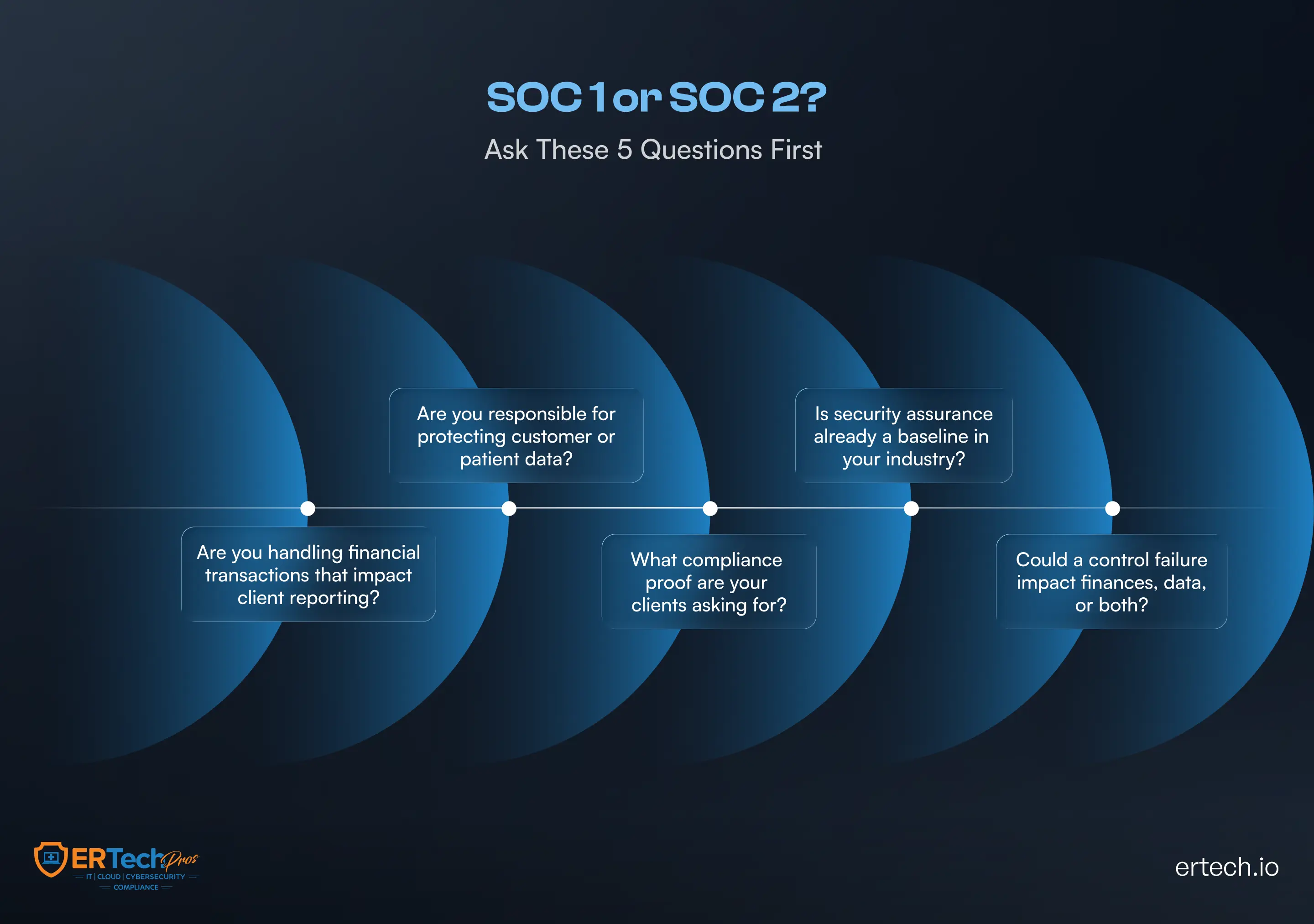
If you are still uncertain whether SOC 1 or SOC 2 is the right path for your organization, work through these questions:
- Do your services directly affect what shows up on a client's financial statements? If yes, transaction processing, payroll, billing, revenue recognition, and SOC 1 compliance are likely what your clients' auditors are looking for.
- Do you store, process, or transmit customer data on behalf of clients? If yes, especially sensitive data like healthcare records, personal information, or enterprise data, SOC 2 certification is the standard your clients will expect.
- What are your enterprise clients or prospects specifically asking for? Client contracts and vendor questionnaires often specify exactly which SOC report is required. That is the clearest signal you have.
- What do competitors in your space carry? Industry norms matter. If SOC 2 compliance has become the baseline in your market, the absence of a report will be noticed, particularly in procurement and security review processes.
- Are you in a regulated industry? Healthcare organizations, financial institutions, and government contractors frequently operate under compliance requirements that make one or both SOC frameworks effectively mandatory rather than optional.
What the SOC Audit Process Looks Like
Whether you are pursuing SOC 1 or SOC 2, the audit process follows a similar structure:
Define the Scope
Determine which systems, services, and locations the report will cover. Scope decisions have a direct impact on audit complexity and cost, and getting them wrong early creates problems later.
Perform a Gap Analysis
Before bringing in an auditor, assess where your current controls stand relative to SOC 1 requirements or SOC 2 Trust Services Criteria. Identifying gaps early gives you time to remediate before the formal audit begins.
Remediate Control Gaps
Build, document, and implement the controls identified by your gap analysis. This is where most of the actual compliance work happens, and where having experienced support makes the biggest difference.
Engage a Licensed CPA Firm
SOC audits must be performed by licensed CPA firms. The auditor evaluates your controls for Type 1 at a point in time; for Type 2, over a six- to twelve-month observation period.
Receive and Distribute Your Report
Your SOC 1 report or SOC 2 report is issued as a confidential document, typically shared under NDA with clients, prospects, and their auditors who have a legitimate need to review it.
Maintain and Repeat SOC
Compliance is not a one-time achievement. Your SOC 2 Type 2 report covers a specific observation period. As soon as that period ends, a new one begins. This means that evidence collection is a year-round activity. The same applies to SOC 1 type 2 audits. Organizations that treat compliance as a continuous discipline rather than an annual scramble consistently produce stronger reports.
How ER Tech Pros Supports SOC Compliance
For healthcare organizations and the technology vendors that serve them, SOC compliance sits alongside HIPAA requirements and the day-to-day operational demands of keeping systems secure and available.
That is exactly the environment ER Tech Pros has been working in for over 27 years.
Our cybersecurity services are built around the controls that SOC 2 compliance demands, and the healthcare-specific risks that make those controls non-negotiable:
24/7 Threat Monitoring and Detection
Continuous monitoring of your administrative systems, actively hunting for anomalies and suspicious behavior before they become incidents. The kind of documented, ongoing monitoring that a SOC 2 type 2 audit will look for across your entire observation period.
Real-Time Incident Response
If a security event occurs, a generic response plan is not enough. Our incident response strategies are built around preserving system access, containing threats rapidly, and restoring all systems while minimizing disruption, all while maintaining the documentation trail that SOC 2 audits require.
Access Controls and Endpoint Security
Role-based access management, endpoint protection across all connected devices, and IoT/IoMT security are foundational controls that appear in both SOC 2 compliance checklists and HIPAA security rule requirements.
Staff Cybersecurity Awareness Training
SOC 2 compliance requires your people to understand their role in maintaining security controls. Our training programs are designed specifically for your staff, because the controls only work if the people operating them understand why they matter.
Compliance-Aligned Security Architecture
We build security architectures that support both care delivery and compliance simultaneously. For organizations working toward SOC 2 certification while maintaining HIPAA alignment, that integration is what makes the difference between a compliance program that holds up under audit and one that creates new findings every year.
Whether your organization is beginning its first SOC 2 audit, preparing for SOC 1 certification as part of a financial services relationship, or trying to understand where your current controls stand relative to either framework, ER Tech Pros can help you build the foundation and maintain it year over year.
Got Questions?
We've Got Answers
Find clear answers to common questions that help guide your IT operations.
Related Content
Medusa Ransomware: What Businesses Can Learn From the Attack
How to Develop a Ransomware Recovery Plan & Prevent an Attack