What Is Vendor Risk Management, and Why Your Business Needs It?
Vendor relationships introduce risk at every stage of your operations. This blog explores what a vendor risk management program is, how it works, and how ER Tech Pros helps businesses manage vendor risk, compliance, and security effectively.
Every vendor your organization works with represents a point of connection into your operations, data, and infrastructure. And every connection point is a potential vulnerability.
Vendor risk management has moved from a compliance checkbox to a business-critical discipline. Organizations that treat it otherwise are operating with a blind spot that attackers already exploit.
The shift is clear: the vendor risk management market is expected to grow from $13.48 billion in 2025 to $24.29 billion by 2030, driven by rising third-party dependencies and stricter compliance demands.
This guide breaks down what a vendor risk management program is, how it works, and how to build one that protects your business across the entire vendor lifecycle.
At ER Tech Pros, we help organizations secure vendor ecosystems through resilient infrastructure, continuous monitoring, and cloud environments designed to reduce risk while supporting growth.
What Is Vendor Risk Management?
Vendor risk management is the structured process of identifying, assessing, monitoring, and mitigating risks posed by third-party vendors and suppliers with access to your organization's systems, data, or operations.
It encompasses everything from the initial vendor risk assessment process before onboarding a new supplier, to the ongoing monitoring of vendor compliance throughout the relationship, to the formal offboarding procedures that ensure access is revoked cleanly when a contract ends.
Why Vendor Risk Has Become a Business Priority?
The modern enterprise runs on a web of third-party integrations, cloud platforms, managed IT services providers, and supplier relationships; each one extending the organization's attack surface beyond its own perimeter.
Third-party vendor risk management has become critical because attackers have recognized this reality before most security teams did. When a direct breach is difficult, targeting a vendor with weaker controls and using that access to reach the primary target has become a standard playbook.
Beyond security, vendor risk encompasses operational continuity, regulatory compliance, financial exposure, and reputational damage. A vendor experiencing a significant disruption doesn't just affect its own business; it affects every organization in its supply chain.
The vendor management lifecycle, from selection through offboarding, is where that risk is either managed or ignored. Organizations that build a disciplined approach to each stage are in a fundamentally stronger position than those that treat vendor relationships as purely commercial arrangements.
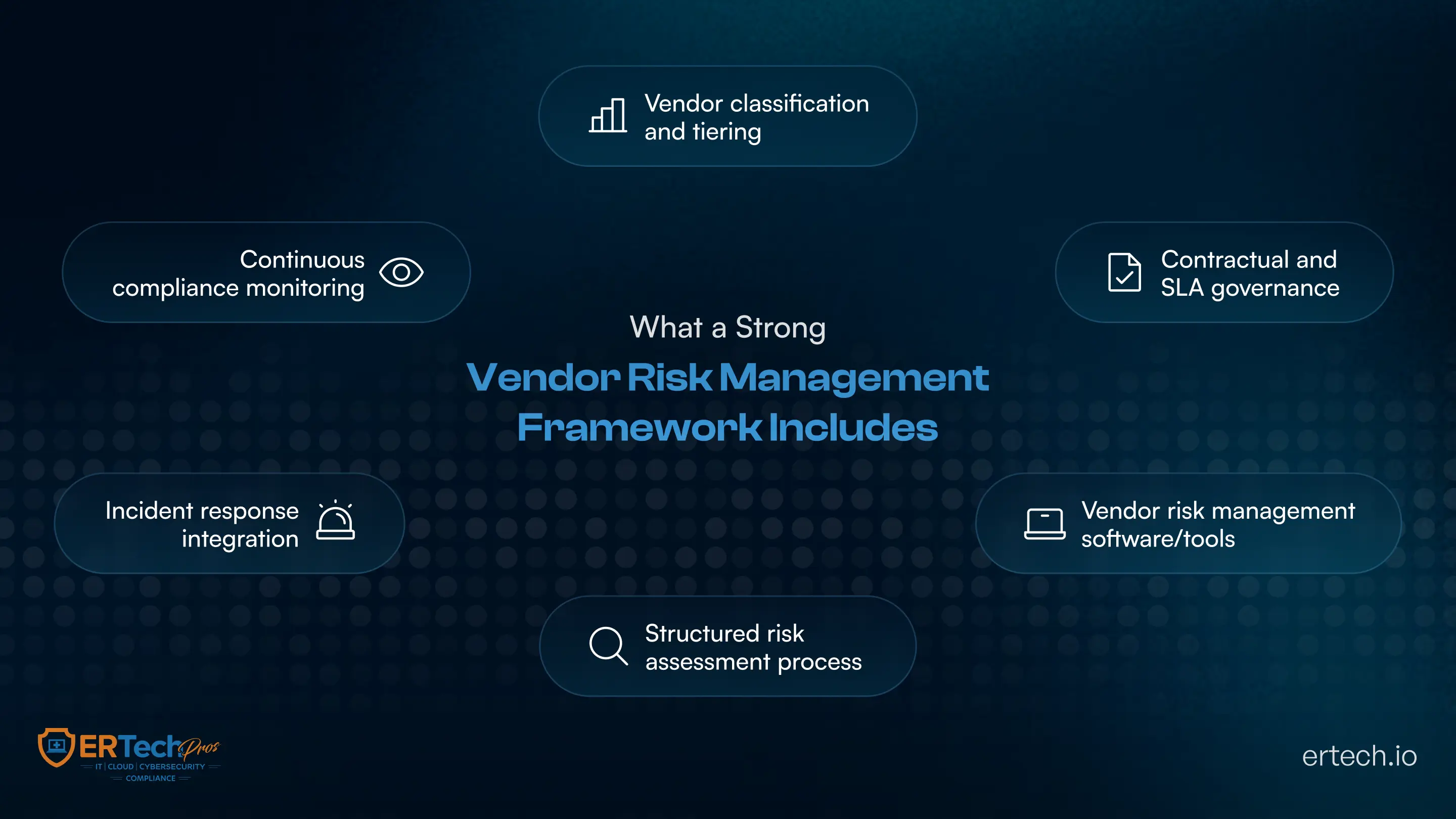
The Core Components of a Vendor Risk Management Framework
A well-constructed vendor risk management framework doesn't treat all vendors the same. It segments them by the level of access they have, the criticality of the services they provide, and the sensitivity of the data they handle, and applies proportionate controls accordingly.
Vendor Classification and Tiering
The first step in any vendor risk management process is classification. Not every supplier warrants the same depth of scrutiny. A vendor with access to your core IT infrastructure carries a fundamentally different risk profile than an office supplies company. Tiering vendors by risk level ensures that your resources and attention go where the exposure is highest.
The Vendor Risk Assessment Process
Once classified, each vendor requires a formal vendor risk assessment, a structured evaluation of their security controls, compliance posture, financial stability, operational resilience, and data handling practices. The vendor risk assessment process should be documented, repeatable, and proportionate to the vendor's tier.
This is where vendor risk assessment tools become critical. Manual assessments don't scale. Organizations managing dozens or hundreds of vendor relationships need vendor risk management software that automates questionnaire distribution, tracks responses, flags gaps, and generates risk scores that inform decision-making. The right vendor risk management software turns what would otherwise be an unmanageable volume of data into actionable intelligence.
Vendor Compliance Monitoring
Vendor risk doesn't end at onboarding. Vendor compliance must be monitored continuously throughout the relationship. Certifications expire. Controls degrade. Personnel changes. A vendor that passed a rigorous assessment two years ago may not meet the same standard today.
Ongoing vendor security risk management requires regular reassessments, continuous monitoring where applicable, and clear escalation paths when a vendor's posture deteriorates. This is the ongoing dimension of vendor relationship management that most organizations underinvest in, and where the greatest exposure tends to accumulate.
Contractual Protections and SLA Governance
A vendor risk management checklist that stops at technical controls is incomplete. Contractual protections are a critical layer of any program. Right-to-audit clauses, data handling requirements, breach notification obligations, and defined SLAs are the operational and financial backstops when a vendor relationship goes wrong.
Incident Response Integration
When a vendor experiences a breach or disruption, your organization needs a clear protocol in place. Who gets notified? What containment steps are taken immediately? How does the incident affect your own regulatory notification obligations? Integrating vendor incidents into your broader incident response framework ensures that third-party events don't create internal paralysis.
Building a Vendor Risk Management Lifecycle
The vendor risk management lifecycle covers every stage of the vendor relationship, and each stage introduces distinct risks that require distinct controls.
Pre-Onboarding: Due diligence before engaging a vendor. This includes the initial vendor risk assessment, security questionnaires, reference checks, and contract review. No vendor should gain access to your environment until this stage is completed.
Onboarding: Controlled provisioning of access, aligned with the principle of least privilege. Only the access necessary for the vendor to perform their function should be granted, and every access point should be documented.
Active Management: Ongoing vendor compliance monitoring, periodic reassessments, and performance reviews. This is where vendor relationship management intersects directly with risk management; the ongoing dialogue with vendors about their security posture is both a relationship and a control.
Offboarding: Formal revocation of all access, recovery of any assets, and documentation of the relationship closure. Incomplete offboarding is one of the most common and least visible sources of residual vendor risk.
The Role of Cloud Infrastructure in Vendor Risk Management
An often-overlooked dimension of supply chain risk management is the IT infrastructure risk assessment that underpins the entire program. The systems your organization uses to manage vendor data, conduct assessments, and monitor compliance are themselves part of your security posture.
Organizations running vendor risk management programs on fragmented, on-premise systems introduce operational and security risks that a well-managed cloud environment eliminates. Centralized data, consistent access controls, automated backups, and real-time availability are basic requirements for a program that needs to operate reliably at scale.
This is where ER Tech Pros cloud hosting services directly support a mature vendor risk management program. ER Tech Pros designs and manages cloud environments built for the performance, security, and availability that operational programs depend on, backed by a 99.99% uptime SLA, enterprise-grade disaster recovery with guaranteed RTO and RPO commitments, and 24/7 NOC monitoring across ER Tech Cloud, AWS, Azure, and GCP.
When your vendor risk management software and assessment data live in a properly managed cloud environment, your program gains the resilience and accessibility it needs to function without disruption. A pay-as-you-go managed cloud hosting model also ensures that your infrastructure scales alongside your vendor portfolio without unnecessary capital expenditure.
Common Gaps in Vendor Risk Management Programs
Understanding what a strong program looks like also means recognizing where programs typically fail.
Treating onboarding as the finish line: The vendor risk assessment process is not a one-time event. Organizations that conduct rigorous pre-onboarding assessments but perform no ongoing monitoring are operating on outdated intelligence.
Inadequate vendor tiering: Applying the same level of scrutiny to every vendor, regardless of their access or criticality, wastes resources and creates false confidence. A tiered approach ensures proportionate controls.
Relying on manual processes: Spreadsheet-based vendor risk management doesn't scale and introduces documentation gaps that undermine the program's integrity. Purpose-built vendor risk management software is not optional for organizations managing significant vendor ecosystems.
Incomplete offboarding: Vendors that have been formally terminated yet retain residual access are among the most underappreciated sources of ongoing exposure. Offboarding must be as disciplined as onboarding.
Siloed ownership: Vendor risk management that lives exclusively in procurement, legal, or IT rather than being shared across functions will inevitably have blind spots. Effective programs require cross-functional accountability.
Why ER Tech Pros Is the Right Partner for Your Vendor Risk Program
Building a vendor risk management program requires the right expertise, tools, and infrastructure to support it. ER Tech Pros brings all three.
With nearly three decades of experience in managed IT services and cybersecurity, we understand the intersection of vendor risk, IT infrastructure risk assessment, and operational security that a comprehensive program demands. Our team combines offensive, defensive, and managed cybersecurity service capabilities, monitoring your environment around the clock and responding immediately when a threat is identified.
And with our cloud hosting services underpinning your infrastructure, your vendor risk management program operates on a foundation built for resilience, security, and scale, so your organization can manage third-party risk with the confidence that your own environment is fully protected.
Got Questions?
We've Got Answers
Find clear answers to common questions that help guide your IT operations.
Related Content
How to Develop a Ransomware Recovery Plan & Prevent an Attack
Ransomware Incident Response Checklist: What to Do in the First 60 Minutes