Top Cybersecurity Challenges Putting Businesses at Risk in 2026
The cybersecurity landscape in 2026 is more complex and more dangerous than at any point in history. This guide breaks down the most critical cybersecurity challenges businesses face today, why they are intensifying, and how ER Tech Pros helps organizations build the resilience to meet them.
Cybersecurity is no longer a background IT concern. It is a front-and-center business risk that demands the same strategic attention as revenue, operations, and compliance, and in 2026, the pressure has intensified significantly!
According to reports, total reported cybercrime losses reached $20.877 billion in 2025, and that figure reflects only what gets reported. The actual scale of cybersecurity breaches runs considerably deeper.
For businesses of every size, understanding the specific cybersecurity challenges driving that acceleration is the first step toward building the cybersecurity strategies and measures needed to meet them.
ER Tech Pros has spent nearly three decades addressing this challenge and helping organizations across healthcare, enterprise, and regulated industries close the gaps that put them at the greatest risk.
This guide breaks down the most critical cybersecurity challenges in 2026 and what effective cybersecurity solutions look like in practice.
The Evolving Sophistication of Cybersecurity Attacks
The nature of cybersecurity attacks has fundamentally changed. The threats targeting businesses today are not the blunt, opportunistic attempts of a decade ago; they are targeted, patient, and increasingly automated, with AI tools making sophisticated attack techniques accessible to a far broader range of threat actors.
Ransomware Has Become a Multi-Stage Operation
The biggest cybersecurity threats, such as ransomware incidents, go well beyond data encryption. They are coordinated campaigns involving data exfiltration before encryption, public exposure threats, and sustained pressure tactics to maximize the likelihood of payment.
The damage extends into regulatory obligations, legal liability, and long-term reputational consequences that outlast the incident itself.
Advanced Persistent Threats Are Escalating
Advanced Persistent Threats (APTs) are long-term, targeted intrusion campaigns, often state-sponsored, designed to establish persistent access, remain undetected for months, and extract high-value data or disrupt critical operations.
A growing share of organizations now account for geopolitically motivated cyberattacks as a real operational risk, including disruption of critical infrastructure and coordinated espionage.
AI Has Made Phishing Unrecognizable
Phishing remains the most common entry point for serious cybersecurity breaches. AI has made it dramatically more convincing, generating personalized, contextually accurate messages at scale that bypass traditional email security filters and exploit human judgment in ways generic campaigns never could.
Effective cybersecurity measures against this evolving threat landscape require continuous monitoring, AI-aware detection, and human expertise that can recognize attack patterns before they escalate into incidents.
The Expanding Attack Surface
Modern business infrastructure has grown considerably more complex, and with that complexity comes a significantly expanded attack surface that cybersecurity systems must cover.
Remote Work and Cloud Adoption Have Dissolved the Perimeter
Remote and hybrid work has moved endpoints outside the traditional network boundary. Employees access sensitive systems from home networks, personal devices, and public connections, each of which is an access point requiring monitoring and protection.
Cloud adoption, SaaS applications, and API integrations all extend the environment an organization must defend, often without the visibility that on-premise systems once provided.
Supply Chain Risk Is the Fastest-Growing Exposure
A vendor, a software provider, and a cloud platform are each a potential entry point into your environment. A breach at a third party can expose your data even when your own cybersecurity systems are functioning correctly.
Effective cybersecurity protocols must therefore extend beyond the organization's perimeter to include vendor risk assessment, third-party access controls, and continuous monitoring of every external connection to your environment.
AI as a Cybersecurity Challenge and a Defense Tool
Artificial intelligence is reshaping cybersecurity from both directions simultaneously.
How Attackers Are Using AI
AI has lowered the cost and skill threshold required to launch sophisticated cybersecurity attacks. Deepfake voice calls impersonating executives, AI-generated malware, and automated vulnerability scanning are now accessible at scale.
Business Email Compromise driven by AI-powered impersonation has become the single most financially damaging cybercrime category. It works because the messages are indistinguishable from legitimate communication.
How Defenders Are Using AI
AI-powered modern security solutions are improving detection speed, accuracy, and response capability in ways that manual cybersecurity practices cannot match. Machine learning models identify behavioral anomalies across complex environments. They flag unusual access patterns and correlate signals across multiple systems simultaneously. This reduces the window between initial compromise and detection, an advantage that attackers have historically relied on.
ER Tech Pros integrates AI-driven threat detection into its monitoring and incident response capabilities, giving clients access to a managed cybersecurity platform that scales across their entire environment without requiring internal AI expertise.
The Cybersecurity Skills Gap
One of the most persistent structural cybersecurity challenges is the shortage of qualified cybersecurity professionals. Demand for threat intelligence analysts, identity and access management specialists, cloud security engineers, and incident responders consistently exceeds supply, and the gap is widening.
For most businesses, building and retaining a full in-house team with the depth required to address today's threat landscape is financially and operationally unrealistic. The organizations reporting the greatest cyber resilience gaps are also those reporting the most acute skills gaps: the two problems reinforce each other!
Managed cybersecurity solutions address this directly. Rather than competing in a constrained talent market, businesses gain immediate access to a team of experienced cybersecurity experts covering every discipline, network security, endpoint protection, cloud security, compliance, and incident response, at a predictable cost and without the overhead of building that capability internally.
Ransomware Incidents and Data Exposure
Modern ransomware operations use double and triple extortion: attackers exfiltrate data before encrypting it, then threaten public exposure or regulatory notification as additional pressure.
The consequences extend far beyond the ransom demand, into notification obligations, legal liability, reputational damage, and the long-term risk of sensitive data circulating in criminal markets.
Most organizations live with an active breach for the better part of a year before detecting it, compounding the damage across every dimension. Effective cybersecurity measures against data exposure require layered defenses working together:
- Endpoint protection that prevents initial execution before ransomware can run
- Network monitoring that detects lateral movement before encryption begins
- Immutable, regularly tested backups that enable full recovery without payment
- Incident response capability that contains and remediates quickly to minimize dwell time
Regulatory Compliance and Cybersecurity Risk Management
Regulatory requirements around data protection and cybersecurity are expanding across industries, and the cost of non-compliance is rising alongside them. For businesses in regulated sectors, maintaining compliance is not just a legal obligation; it is a foundational component of a sound organizational cybersecurity posture.
For example, HIPAA in healthcare imposes specific requirements around cybersecurity systems, data handling, access controls, incident response, and documentation. The challenge for most organizations is not understanding what compliance requires in principle, but translating those requirements into operational cybersecurity practices that hold up under audit and provide genuine protection rather than just documentation.
The most effective cybersecurity initiatives treat regulatory frameworks as a floor rather than a ceiling. Organizations that build cybersecurity programs around genuine risk reduction rather than minimum compliance tend to be more resilient, more defensible in the event of a breach, and better positioned in regulatory reviews.
ER Tech Pros delivers compliance-aligned security programs for regulated industries, with HIPAA-compliant infrastructure management, full regulatory documentation, and cybersecurity risk management frameworks that align with the specific requirements of each client's sector.
Maintaining Organizational Cybersecurity Posture Over Time
Perhaps the most underappreciated cybersecurity challenge is not any single threat vector; it is the ongoing difficulty of maintaining a strong organizational cybersecurity posture across a continuously changing environment.
Security programs degrade without active management. New systems are added without corresponding updates to the access policy. Software goes unpatched as operational priorities compete with maintenance schedules.
Employees change roles and accumulate permissions beyond what their current function requires. Vendors gain access and retain it longer than the engagement warrants. Each of these changes, individually modest, collectively erodes the security foundation an organization has built.
Maintaining strong cybersecurity practices requires treating security as an ongoing operational discipline rather than a periodic project. That means:
- Continuous monitoring and vulnerability assessment
- Structured access reviews and defined patch management schedules
- Security awareness programs that keep the human layer of defense current
- Proactive refinement of cybersecurity protocols as threats evolve
The divide between well-resourced and under-resourced organizations is widening, and the organizations most at risk are those that treat cybersecurity posture as something to revisit quarterly rather than manage daily.
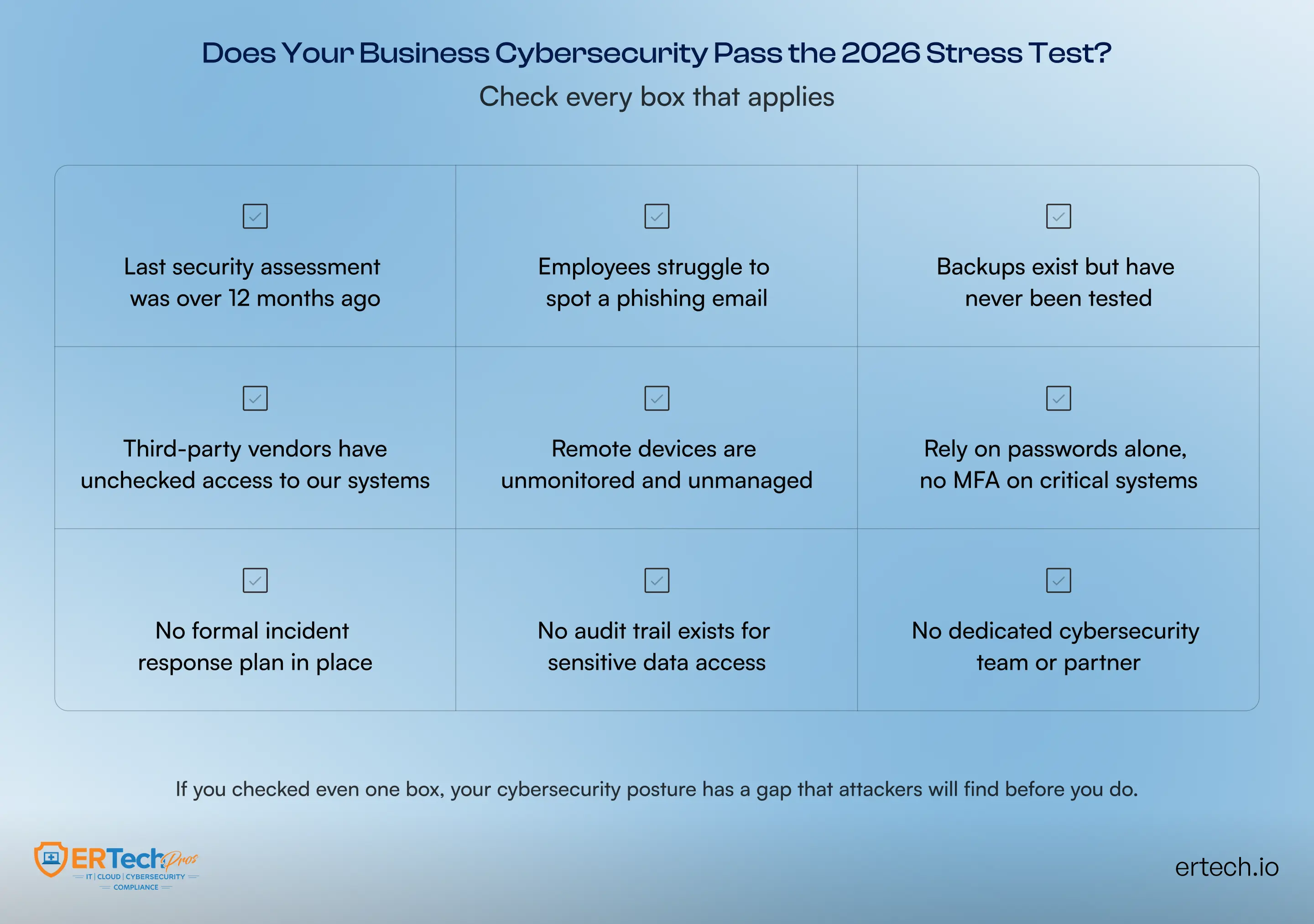
Get a FREE Audit With ER Tech Pros
How ER Tech Pros Addresses These Cybersecurity Challenges
The organizations that navigate cybersecurity challenges most effectively are not necessarily the ones with the largest budgets; they are the ones with the right cybersecurity strategies, the right partners, and the operational discipline to maintain their defenses consistently.
ER Tech Pros delivers comprehensive, integrated cybersecurity solutions built around how businesses actually operate:
- 24/7 Security Operations Center- Cybersecurity professionals monitoring client environments continuously, detecting threats, and responding to incidents with expertise specific to each client's environment.
- AI-aware threat detection- Machine learning integrated into monitoring and response, keeping detection coverage pace with AI-driven attack methods reshaping the threat landscape.
- Compliance-aligned security programs- Serving regulated industries with HIPAA-compliant infrastructure, full regulatory documentation, and cybersecurity risk management frameworks aligned to each client's sector.
- Vendor risk assessment- Extending cybersecurity protocols beyond the organizational perimeter to address supply chain exposure, one of the fastest-growing cybersecurity risk categories.
- Cybersecurity awareness programs- Building the human layer of defense that technical controls alone cannot provide, training staff to recognize the social engineering and phishing techniques that remain the most common entry points for serious cybersecurity breaches.
Proactive and Integrated: The Only Effective Response to 2026's Cybersecurity Challenges
The cybersecurity challenges businesses face in 2026 are not going to get any simpler. AI-powered attacks will become more sophisticated. The attack surface will continue to expand. Regulatory requirements will grow more stringent.
What determines whether organizations navigate these challenges successfully is the quality of their cybersecurity strategies, the consistency of their cybersecurity measures, and the strength of their partnerships with cybersecurity experts who provide genuine protection.
ER Tech Pros helps businesses build that resilience that covers every layer of an organization's environment. Proactively, consistently, and at a scale that fits how businesses actually operate.
Got Questions?
We've Got Answers
Find clear answers to common questions that help guide your IT operations.
Related Content
Ransomware Incident Response Checklist: What to Do in the First 60 Minutes
How to Build an Effective Ransomware Response Plan