Understanding the Basics of Cybersecurity: What Every Healthcare Provider Needs to Know
Healthcare is the #1 target for cybercriminals. Learn the basics of cybersecurity and how ER Tech Pros helps protect your patients, data, and reputation.
When you decided to go into healthcare, you probably weren't thinking about becoming an IT security expert. You wanted to take care of patients, not spend your time worrying about hackers and data breaches. But here we are in 2026, and understanding cybersecurity has become just as important to running a medical practice as having the right medical equipment or a qualified staff.
The statistics are genuinely alarming. According to the HIPAA Journal, Healthcare has been the costliest industry for data breaches for 14 straight years, with the average breach now costing $7.42 million.
Behind each of these numbers is a real medical practice dealing with absolute chaos. There are anxious patients who've lost trust in their providers, operations that have come to a complete standstill, and financial consequences that can be devastating.
But here's some good news: you don't need to become a tech expert to protect your practice. You just need to understand the basics of cybersecurity and partner with companies like ER Tech Pros, who know what they're doing!
What Is Cybersecurity in Healthcare?
Think of cybersecurity services as the digital version of locking your clinic doors at night. It's really about combining practices, technologies, and processes that protect your networks, devices, and data from attacks, damage, or unauthorized access.
In healthcare, though, cybersecurity takes on a whole different level of importance. You're not just protecting business information like sales figures or marketing plans. You're safeguarding patient lives. When your electronic health records (EHR) system goes down during a cybersecurity attack, patients can't get the care they need. When protected health information (PHI) gets stolen, people face identity theft and privacy violations that can never be completely undone.
Data security is a critical piece of this bigger cybersecurity puzzle. It focuses specifically on keeping digital information safe throughout its entire journey. From the moment patient data is created to when it's stored, transmitted, and eventually archived, data security ensures it remains confidential, accurate, and accessible only to those who need it.
At ER Tech Pros, we've spent over 27 years working exclusively with healthcare organizations, so we understand that your cybersecurity needs are unique. Medical practices face regulatory requirements that other industries don't, and the consequences of cybersecurity incidents in healthcare extend far beyond financial loss.
The Cybersecurity Threats Targeting Healthcare Right Now
Today's cybersecurity threats aren't what they used to be. Cybercriminals have become sophisticated, well-organized, and they know exactly how valuable healthcare data is on the black market. Here's what you're actually up against.
Ransomware attacks have honestly become healthcare's worst nightmare. Hackers break into your systems, encrypt all your data, and then demand payment to give it back. Between 2018 and 2022, ransomware hit 654 healthcare organizations and exposed 88.8 million patient records. But it's not just about paying the ransom. It's about patients being turned away at the door, surgeries getting delayed for weeks, and your entire staff trying to work with paper records.
Phishing schemes remain incredibly successful because they target people rather than technology. One of your employees gets what looks like a completely legitimate email, clicks a link without thinking twice, and suddenly, attackers are inside your network. These cybersecurity attacks work so well because they exploit basic human nature. We're helpful, we're curious, and sometimes we're just distracted during those crazy busy days during business hours.
Malware can slip into your systems through all kinds of routes, stealing data, disrupting your operations, or creating backdoors for future cybersecurity attacks. Once malware gets inside your network, it spreads quickly across all your connected systems.
Cybersecurity online vulnerabilities have absolutely exploded with the rise of telehealth and remote work. You've got staff accessing your EHR from home, using personal devices for work tasks, or connecting through coffee shop Wi-Fi. These create entry points that simply didn't exist back when everyone worked on-site from 9 to 5.
The Insider Threat Nobody Wants to Talk About
Here's an uncomfortable truth about cybersecurity that most people don't want to face: some of your biggest risks walk through your front door every single morning. Insider threats in cybersecurity come from people who already have authorized access to your systems. That means your own staff, contractors, or business partners.
Now, before you start suspecting everyone on your team, let’s be clear about something. Most insider threats in cybersecurity aren't malicious at all. They're completely accidental. A nurse accessing a celebrity patient's chart out of curiosity. A receptionist accidentally emailed PHI to the wrong person. A physician's assistant falls for a phishing email while rushing between patients during a hectic afternoon.
Whether the insider threat is intentional or accidental, the damage can be absolutely severe. In 2024, 70% of breach actors were internal to the organization. The real challenge with insider threats in cybersecurity is that these activities often look completely legitimate in your system logs, making them nearly impossible to detect until it's way too late.
This is exactly why cybersecurity awareness training is essential in every healthcare practice.
Different Types of Cybersecurity You Actually Need
Effective cybersecurity in healthcare means multiple layers of protection working together to keep your practice safe. Understanding the main types of cybersecurity helps you see where gaps might exist in your current setup.
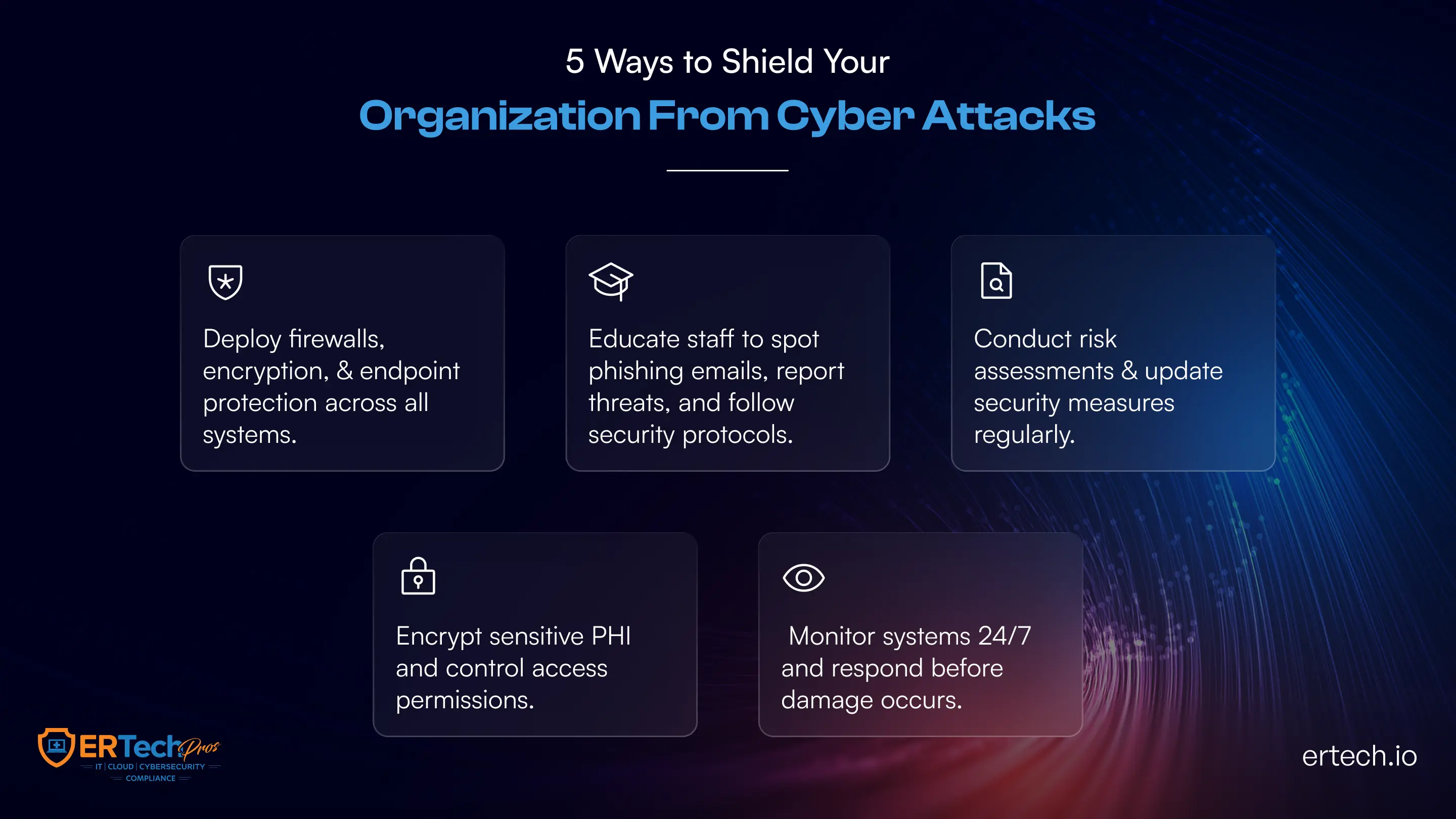
Network Security: Protects your computer networks with firewalls, intrusion detection systems, and monitoring tools that watch for suspicious activity attempting to access your systems.
Application Security: Keeps your EHR, telehealth platforms, and billing software safe from exploitation and cyber attacks that target the programs you use every day.
Information Security: Protects data by encrypting it and enforcing strict access controls, ensuring patient information remains confidential and secure.
Endpoint Security: Safeguards every device that connects to your network, including computers, tablets, smartphones, and medical devices that may be vulnerable to attacks.
Operational Security: Handles the human side of things, controlling who can access what information and how, ensuring your team follows proper protocols.
Disaster Recovery and Business Continuity: Planning helps ensure you can continue operating even during serious cybersecurity incidents, so patient care never stops.
ER Tech Pros specializes in implementing all these types of cybersecurity in a way that makes sense for healthcare practices. We build layered defense systems, monitor for threats 24/7, and contain them before they disrupt your operations, allowing your team to do their jobs efficiently.
Why Cybersecurity Awareness Is Your Best Defense
You could have the most expensive cybersecurity technology money can buy, but one person clicking the wrong link can undo all of it in seconds. Humans are often called the weakest link in cybersecurity, which is exactly why cyber awareness programs matter so much.
Cybersecurity awareness means your entire team understands the threats you face and knows exactly how to respond when something seems off. It creates a culture in which security is everyone's responsibility, not just the IT person's job. Good training teaches your staff how to spot phishing emails, create strong passwords that actually protect accounts, understand why access limitations exist, and report suspicious activity immediately.
For healthcare specifically, cybersecurity awareness needs to extend far beyond just your IT department. Everyone who touches patient data needs training. That includes physicians, nurses, front desk staff, billing specialists, and even cleaning crews who have access to computers after hours. When everyone on your team understands their role in protecting the practice, you create powerful human defense layers that work alongside your technical safeguards.
We've found that healthcare staff respond best to training that uses real scenarios they might actually encounter. That's why ER Tech Pros designs cyber awareness programs specifically for medical practices, with examples and simulations that feel relevant to their daily work.
When Cybersecurity Incidents Strike Your Practice
Despite your best efforts at prevention, cybersecurity incidents can still happen. The question isn't really if, but when. Having a solid incident response plan makes all the difference in how quickly you recover and how much damage occurs.
A good incident response plan covers several phases.
- Preparation: Having tools, processes, and trained people ready before anything happens so you're not scrambling during a crisis.
- Detection and Analysis: Figuring out what's actually going on when something seems wrong and understanding the scope of the incident.
- Containment: Stopping the incident from spreading further and affecting more systems or data.
- Eradication: Removing the threat completely from your systems so it can't come back.
- Recovery: Restoring normal operations and ensuring all systems are functioning properly.
- Post-Incident Review: Learning lessons from what happened to prevent the same thing from happening again.
ER Tech Pros anticipates threats and responds immediately with strategies designed specifically for healthcare environments. We understand that you need to continue seeing patients even as we contain threats and restore systems. Our 24/7 threat monitoring catches many incidents before they become full-blown disasters, and our incident response team knows how to work within the realities of clinical operations.
Build a Stronger Defense With ER Tech Pros
Understanding cybersecurity basics is crucial, but implementing them in real-world healthcare environments requires specialized expertise that most practices lack in-house.
ER Tech Pros has spent over 27 years protecting healthcare organizations from experiencing a breach. We understand that when your systems go down, patient care stops completely. That's why our proactive threat monitoring is designed specifically for medical practices. We actively hunt for threats targeting EHR systems, stay ahead of healthcare-focused ransomware, and build cybersecurity risk management frameworks that align with HIPAA requirements while fitting your clinical workflows and budget.
We implement comprehensive data security measures, including encrypted backups, strict access controls, and disaster recovery plans designed for PHI. We secure medical devices without compromising patient care and manage risks from third-party vendors, such as lab services and billing companies. Our team provides 365 days of human support, not automated responses or offshore call centers!
Your patients trust you with their health and most sensitive information. That trust deserves protection beyond minimum compliance. Don't wait for cybersecurity incidents to expose gaps in your defenses.
Contact us today for a comprehensive security assessment. We'll show you where you stand, identify your biggest vulnerabilities, and create a practical roadmap for building robust defenses that protect your patients and practice.
Got Questions?
We've Got Answers
Find clear answers to common questions that help guide your IT operations.
Related Content

IT Disaster Recovery Plan for Small Businesses: A Complete Guide
Cybersecurity Awareness Month: 14 Security Steps Every Business Should Take in 2026