Cybersecurity Pricing Explained: Costs, Risks, and ROI in 2026
Understand what drives cybersecurity cost in 2026, how pricing works, and how ER Tech Pros helps businesses maximize ROI with the right security strategy.
Cybercrime losses in the United States alone reached $16.6 billion in 2024, according to the FBI's Internet Crime Report. And that number only reflects reported incidents; the actual damage runs deeper. For businesses, the stakes couldn't be higher. A cyberattack today doesn't just disrupt operations; it can end them.
Small businesses that experience a significant cyberattack often don't survive the following six months. The threat is not theoretical, and the window to act proactively is narrowing every year.
What most businesses lack isn't motivation, it's clarity. What does comprehensive cybersecurity actually cost in 2026? What's driving those numbers up? And how do you know whether your current IT security investment is proportionate to the risk you're actually carrying?
At ER Tech Pros, we help businesses answer exactly those questions with real numbers, honest assessments, and security programs built around how organizations actually operate. This blog breaks down the full cost picture so you can make informed, confident decisions before a crisis forces your hand.
What Determines Cybersecurity Costs in 2026?
Cybersecurity pricing varies widely, and for good reason. Every business carries a different combination of risk, infrastructure, and regulatory obligation, and your security program needs to reflect that reality, not a one-size-fits-all package.
Here are the key factors that influence cybersecurity costs:
The size of your organization is one of the most direct drivers of cybersecurity costs. Most managed security services are priced per user or per device, which means costs naturally increase as your workforce grows and more systems need to be secured and monitored.
Industry and Compliance Requirements
Regulatory obligations can significantly increase cybersecurity investments. Businesses that must comply with frameworks like HIPAA, PCI-DSS, or SOC 2 require more advanced controls, continuous monitoring, and detailed reporting. While these requirements add to the cost, they also help avoid serious penalties and legal risks associated with non-compliance.
Current Security Posture
Your existing security environment plays a major role in determining costs. Organizations with outdated systems, unpatched software, or no formal security policies often require more upfront investment to establish a strong foundation. In contrast, businesses with basic security practices already in place can build on that foundation more efficiently.
Remote work and Third-Party Exposure
Modern work environments have expanded the attack surface for most businesses. Remote employees, third-party vendors, and cloud-based platforms introduce additional access points that must be secured, monitored, and managed continuously, increasing the overall cybersecurity costs.
In-House vs. Managed Security Services
The way cybersecurity is delivered significantly impacts overall costs. Building an in-house security team entails substantial expenses, including salaries, tools, and ongoing training, yet maintaining true 24/7 coverage remains difficult. Partnering with a managed security services provider like ER Tech Pros offers a more scalable and cost-effective approach, providing access to specialized expertise, advanced tools, and round-the-clock monitoring at a predictable monthly cost.
At ER Tech Pros, our approach begins with a comprehensive risk assessment to understand your current environment. This ensures your cybersecurity investment is focused on real vulnerabilities and delivers measurable value.
How Businesses Are Investing in Cybersecurity
According to Gartner, worldwide end-user spending on information security is projected to reach $213 billion in 2025, up from $193 billion in 2024, with forecasts estimating a further 12.5% increase in 2026, reaching approximately $240 billion. This steady growth reflects organizations' continued prioritization of cybersecurity as a core business investment.
Several factors are contributing to rising cybersecurity pricing across industries. Increasing attack frequency, evolving regulatory requirements, and the rapid adoption of cloud technologies have all expanded the scope of what businesses need to protect. At the same time, advancements in AI are influencing both attackers and defenders, adding another layer of complexity to the security landscape.
Security software remains one of the fastest-growing segments, particularly as businesses shift to cloud-based environments that require continuous monitoring and advanced threat-detection capabilities.
At ER Tech Pros, our approach starts with a comprehensive risk assessment to understand where your business stands today. This ensures your cybersecurity ROI is maximized and your IT security investment is focused on addressing real vulnerabilities, not just checking boxes.
Core Cybersecurity Expense Categories
Understanding how your IT security investment is allocated is essential to building an effective and well-structured cybersecurity program.
These are the categories that form the backbone of a modern security program.
Network Security: Firewalls, intrusion detection, and continuous monitoring form your first line of defense. Without a secure network foundation, other security measures become significantly less effective.
Endpoint Security: Protects every device connected to your environment. With hybrid work now a permanent fixture for most businesses, endpoints represent one of the largest and fastest-growing areas of exposure.
Email Security: Remains a primary entry point for cyberattacks. Phishing remains one of the most common attack methods across industries, targeting human behavior rather than technical vulnerabilities. Advanced filtering and simulated phishing training are both essential components.
Backup and Disaster Recovery: Critical for business continuity. Encrypted, off-site, and regularly tested backups allow organizations to recover quickly from system failures, without paying a ransom.
Compliance and Risk Management: Ensures your security program aligns with regulatory requirements, helping reduce both breach risk and potential legal or financial penalties.
At ER Tech Pros, these components are delivered as part of an integrated security program, not as a collection of disconnected tools that leave gaps.
The Hidden Costs Most Businesses Don't Budget For
Every cybersecurity proposal covers the visible costs. These are the ones that don't show up until something goes wrong.
Operational downtime: The most underestimated consequence of a cyberattack. When systems go offline, business operations are disrupted. For many businesses, a single day of downtime costs more than months of cybersecurity investment.
Third-party vendor exposure: Extends risk beyond your internal environment. Payroll providers, cloud platforms, and software vendors all represent potential entry points. A breach at a vendor can expose your data even if your own systems were not directly targeted. At ER Tech Pros, we include vendor risk assessment as a core part of our security reviews because risk doesn’t stop at your perimeter.
Cyber insurance requirements: This has become more stringent as claims have surged. Insurers now expect documented controls such as multi-factor authentication, endpoint protection, and verified backups before issuing coverage. Gaps in your security posture can not only increase risk but may also impact your eligibility for claims.
Post-breach recovery: Costs often extend beyond the initial incident. Forensic investigations, legal counsel, regulatory notifications, and customer remediation can extend for months. Research shows that a significant portion of breach-related costs materialize long after the event itself.
The Cost of a Data Breach in 2026
The financial impact of a cyberattack continues to rise, making cybersecurity investment a critical business decision.
According to reports, the average cost of a data breach across all industries now exceeds $4.88 million. For small businesses specifically, breach costs can quickly escalate due to downtime, recovery efforts, and operational disruption.
Ransomware tells an even sharper story, often resulting in extended downtime, data loss, and costly recovery efforts. Now run the comparison, expenses such as legal support, regulatory requirements, and reputational damage can continue well after the breach.
Managed security services deliver continuous protection and expert oversight at a cost that is significantly lower than the impact of a single serious cyber incident.
The takeaway is simple: investing in prevention is far more cost-effective than managing the consequences of a breach.
How AI Is Changing Cybersecurity Pricing
Artificial intelligence is reshaping the economics of cybersecurity from both directions, making it a key factor in IT security investment decisions.
On the attacker side, AI has lowered the cost and skill required to launch sophisticated attacks. Convincing phishing emails can now be generated at scale, and processes like vulnerability scanning are increasingly automated. As highlighted by the World Economic Forum, AI is enabling cybercriminals to scale attacks faster and with greater precision, significantly lowering the barrier to entry for sophisticated threats.
On the defense side, AI-powered tools are improving detection speed and accuracy. Modern managed security services use machine learning to identify behavioral anomalies, flag unusual access patterns, and respond faster than manual processes alone. Industry insights also note that AI-driven cybersecurity is becoming essential, as organizations shift toward faster, more adaptive threat detection and response.
This evolution is influencing how cybersecurity investments are structured. Organizations are adopting more advanced, AI-driven tools to keep pace with emerging threats while improving overall efficiency and response capabilities.
At ER Tech Pros, we integrate AI-driven threat detection into our monitoring and response capabilities, giving clients access to advanced security technologies in a scalable and cost-effective way.
How ER Tech Pros Helps Businesses Control Cybersecurity Costs
After nearly 3 decades of protecting organizations across industries, our approach comes down to one thing: effective security has to fit how your business actually operates. Generic packages and offshore support don't deliver real protection; they deliver a false sense of security.
Here's what that looks like in practice, step by step:
Step 1: Assess Your Current Environment
We start with a comprehensive risk assessment to understand your vulnerabilities, workflows, third-party exposure, and compliance requirements.
Step 2: Align Your Security Priorities with Budget
We map your security needs to the right level of investment, ensuring your resources are focused where they deliver the most value. Our managed security services pricing is transparent and predictable, giving you full visibility into what you’re investing in, without unexpected costs or unclear billing.
Step 3: Secure Your Systems and Infrastructure
We implement integrated security controls across your network, endpoints, and systems, designed to protect without disrupting operations.
Step 4: Monitor and Respond in Real Time
With 24/7 monitoring and 365-day human support, we detect threats, contain them, and respond in real-time to prevent escalation.
Step 5: Optimize Your Security Performance
We proactively refine your security program to eliminate gaps, reduce inefficiencies, and improve overall effectiveness.
Step 6: Scale Security as You Grow
As your business evolves, your security program scales with it, ensuring long-term protection and consistent cybersecurity ROI.
The Result
A streamlined, cost-effective cybersecurity program that protects your business today while adapting to tomorrow’s risks.
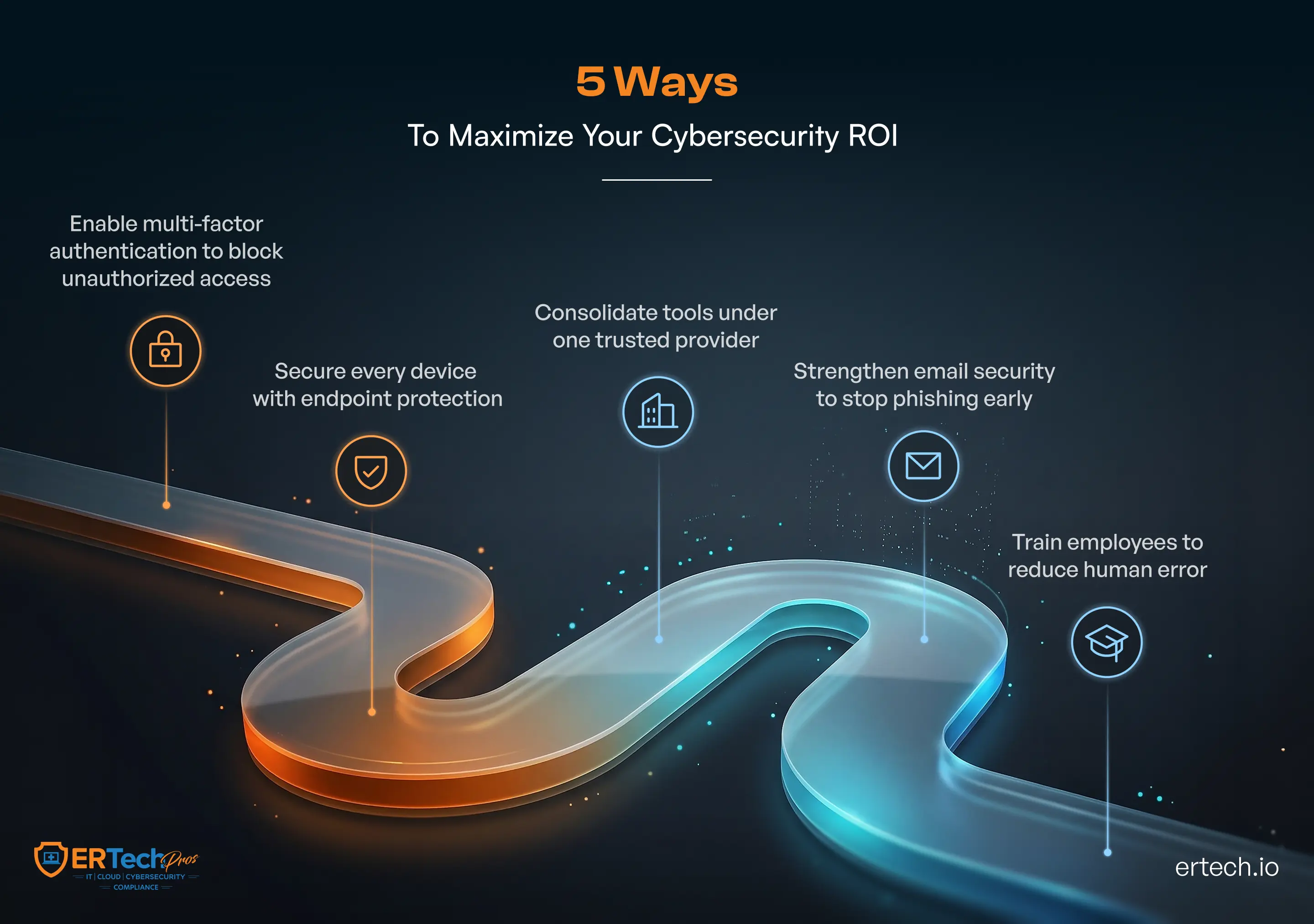
Make Cybersecurity a Strategic Investment
The businesses that manage cybersecurity effectively in 2026 aren’t necessarily spending more; they’re spending with clarity. They understand their risks, work with the right cybersecurity partners, and build security programs that evolve as threats do.
Every unresolved gap is an opportunity for attackers. Many organizations only act after an incident, when what seemed like a cost-saving decision turns into a far greater financial and operational impact.
Cybersecurity investment is real, measurable, and predictable, and it's one of the most effective ways to protect long-term business value. The alternative isn't saving money. It's borrowing time. With the right partners like ER Tech Pros, you’re not reacting to threats; you’re staying ahead of them!
Got Questions?
We've Got Answers
Find clear answers to common questions that help guide your IT operations.
Related Content

Cybersecurity Awareness Month: 14 Security Steps Every Business Should Take in 2026
Medusa Ransomware: What Businesses Can Learn From the Attack