
Financial Cybersecurity: Protecting Client Data and Staying Compliant
Financial institutions sit at the intersection of money, data, and regulation, which makes them one of the most targeted sectors in cybersecurity. This guide breaks down what it takes to protect client data and meet compliance requirements.
Few industries carry as much combined weight as financial services. Every transaction carries financial value, every account contains sensitive information, and every institution operates within a complex regulatory environment.
The growing threat from AI-driven attacks makes that challenge even more pressing. According to the latest research, financial services was among the two most targeted sectors for AI-driven attacks, with the average cost of a breach reaching USD 6.29 million.
That figure reflects more than the immediate cost of compromised data. A serious incident can result in fraud losses, operational disruption, regulatory exposure, litigation, and the long-term cost of rebuilding client trust. For a bank, credit union, lender, or wealth management firm, cybersecurity isn't a back-office IT concern. It's a core part of protecting the business and the clients who depend on it.
This guide examines what cybersecurity for financial services entails: the sector-specific threats, the compliance obligations layered on top of standard security practices, and how institutions of all sizes can strengthen their security posture while protecting client data and meeting regulatory expectations.
Don't Wait for an Incident to Find the Gaps
Why Cybersecurity in Finance Looks Different From Every Other Industry
Most industries protect data. Financial institutions protect data and the money associated with it in real time. A compromised bank account can trigger a wire transfer, a fraudulent loan application, or unauthorized access to an entire household's financial picture. That difference changes the calculus of financial cybersecurity: it isn't only about keeping intruders out; it's about assuming that if they get in, the damage compounds immediately and is financially costly.
The attack surface has also grown more complex. Core banking platforms, payment processors, mobile apps, and a growing web of fintech integrations all touch the same client data, often through APIs that weren't part of the environment five years ago. Each of those connections is a potential point of failure, and attackers know it.
Credential stuffing against online banking portals, business email compromise targeting wire transfers, and ransomware aimed at disrupting operations remain among the biggest cybersecurity threats financial institutions face today. Alongside these persistent risks, increasingly convincing AI-generated phishing campaigns are making it more difficult to protect both employees and customers.
None of this means financial institutions are defenseless. It means cybersecurity in finance has to be built on the understanding that the target isn't just information; it's liquidity, and response-time expectations are correspondingly tighter.
The Regulatory Landscape Shaping Cybersecurity for Financial Services
Financial institutions don't get to define their own security bar. Regulators have already set much of it, and that framework is often what separates cybersecurity for financial services from generic IT security work.
For example, the Gramm-Leach-Bliley Act (GLBA) establishes safeguards for customer information, while PCI DSS applies to organizations that store, process, or transmit payment card data. SEC-reporting companies also face specific cybersecurity disclosure requirements for material incidents. At the same time, state-level regulations such as New York's 23 NYCRR Part 500 impose additional cybersecurity requirements on covered entities regulated by the New York Department of Financial Services.
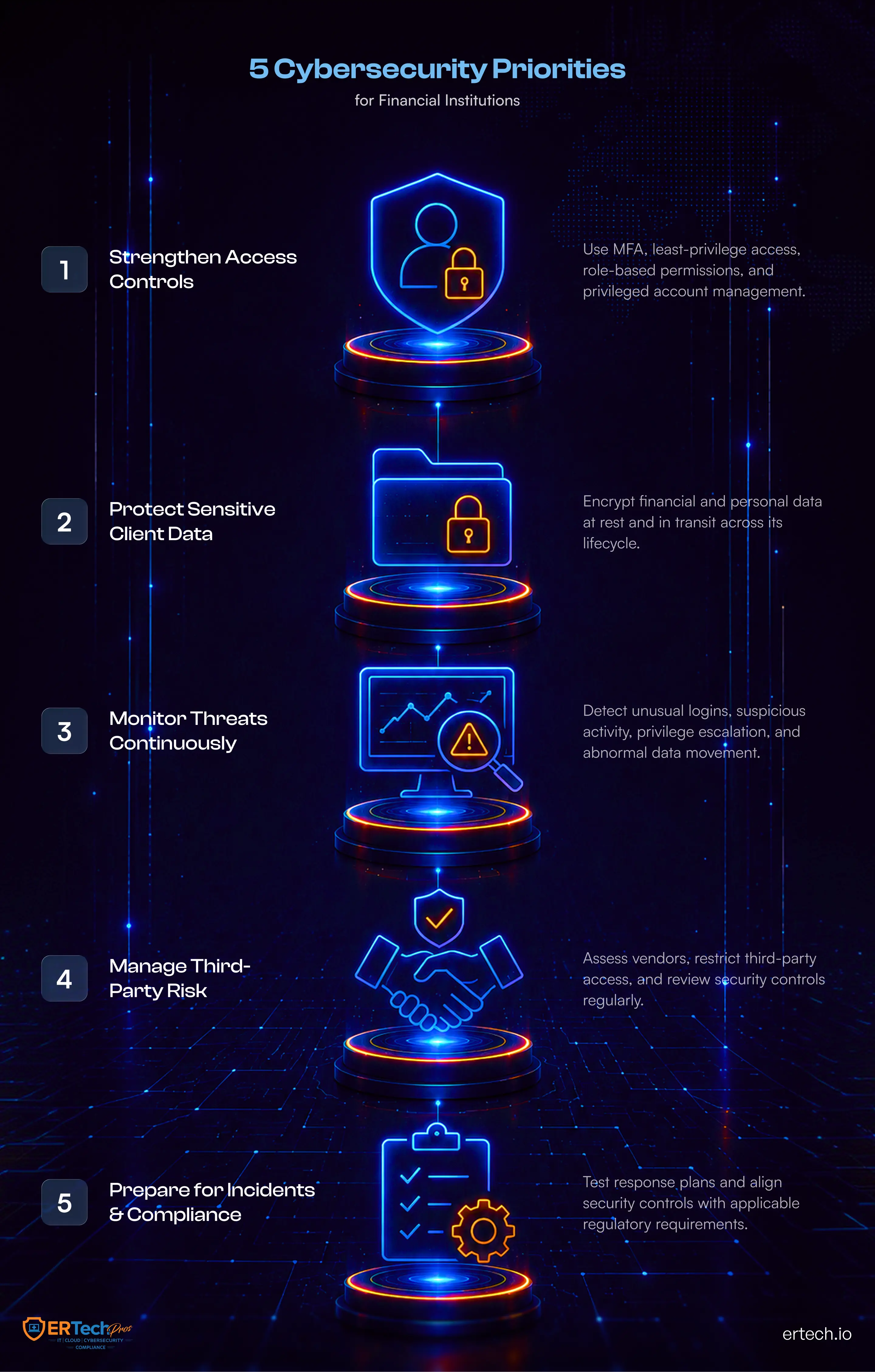
For financial institutions, compliance should not be treated as a separate exercise from cybersecurity. The same controls that protect client data- strong access management, encryption, monitoring, incident response, and third-party oversight- can also provide the foundation for meeting applicable regulatory requirements.
Understanding What Qualifies as a Data Breach Under Financial Regulations
One of the more common points of confusion inside financial institutions is what qualifies as a data breach in the eyes of a regulator versus what feels like an internal security event. An employee accessing an account outside their job duties, a misconfigured cloud bucket exposing account numbers, or a vendor losing a laptop containing client records can all trigger notification obligations, even if no attacker was ever involved. Building a program that treats these situations with the same seriousness as an external attack is part of what keeps an institution compliant rather than caught off guard.
How SOC Reports Strengthen Third-Party Security
Financial institutions are increasingly expected to demonstrate the strength of their own controls, not just describe them. This is where the distinction between SOC 1 and SOC 2 compliance reports becomes relevant: SOC 1 focuses on controls relevant to financial reporting, while SOC 2 evaluates controls related to security, availability, and confidentiality more broadly.
Understanding which report applies, and being able to produce one when a partner bank, auditor, or client asks for it, has become a practical requirement for doing business in the sector, not just a compliance nicety.
Core Principles of Cybersecurity Financial Institutions Should Build Around
Regulatory requirements set the floor, but strong institutions build well above it. The core principles of cybersecurity that matter most in financial services aren't exotic; they're the fundamentals, applied with more discipline given what's at stake.
Access Control Protocols for Highly Regulated Environments
Financial data should never be one password away from exposure. Strong access control protocols combine multi-factor authentication, role-based permissions that limit employees to exactly what their jobs require, and privileged access management for anyone with administrative rights to core systems.
Access reviews should occur on a set schedule, and any role change or departure should trigger immediate revocation, since lingering access from a former employee or a role change is one of the most common gaps auditors find.
Encryption and Secure Cloud Infrastructure
As more institutions move core systems off legacy infrastructure, the environment in which those systems live matters as much as the controls layered on top.
Secure cloud hosting built for compliance, meaning infrastructure configured with encryption at rest and in transit, documented access logging, and architecture that maps cleanly to frameworks like PCI DSS and GLBA, gives institutions a foundation that can actually support an audit rather than complicate one.
Protecting Client Data Across the Institution
Client data moves through onboarding forms, core banking systems, mobile apps, call center notes, and eventually into archives or is disposed of. Protecting it means considering the entire lifecycle, not just securing a single database and calling it done.
That includes the people handling the data every day. Employees across a financial institution, not just IT staff, need to recognize a convincing phishing attempt and know to report phishing emails immediately rather than deleting them or assuming someone else caught it.
The faster a suspicious email is flagged, the smaller the window an attacker has to act on stolen credentials. Many of the cybersecurity best practices that apply broadly across industries- strong password hygiene, verifying unusual requests through a second channel, locking devices when unattended- matter even more in financial services, where a single compromised login can reach directly into client funds.
Managing Third-Party and Vendor Risk in Financial Services
Very few financial institutions run their entire technology stack in-house. Core processors, payment gateways, loan origination platforms, and marketing tools typically involve outside vendors, extending the institution's attack surface into systems it doesn't directly control.
A structured vendor risk management program addresses this by evaluating a vendor's security posture before onboarding, using standardized questionnaires rather than informal assurances, limiting each vendor's access to the minimum required for their function, and reassessing that access periodically rather than treating onboarding as a one-time checkpoint. Regulators increasingly expect institutions to demonstrate this kind of oversight, and clients do too, even if they never see it directly.
How ER Tech Pros Delivers Cybersecurity Consulting for Financial Services
Every institution's environment looks a little different, shaped by its size, its regulators, and the systems it has accumulated over time. That's the gap ER Tech Pros is built to close: assessing where an institution stands relative to the frameworks that apply to it, then building a roadmap rather than a generic checklist.
Building and maintaining a comprehensive security program internally can also be a significant undertaking. Our managed cybersecurity services for financial services extend internal IT capabilities with 24/7 monitoring through a dedicated Security Operations Center, AI-powered threat detection, and incident response support. This gives financial institutions continuous oversight without requiring them to build and staff every security function in-house.
For institutions further along in their security maturity, we help develop a broader strategy that sequences these efforts over time, so that improvements build on each other rather than arriving as disconnected projects. That's also the core of managed cybersecurity solutions for regulated industries more broadly: the goal isn't a single audit pass; it's a program that holds up the next time a regulator, client, or attacker comes asking.
Move Closer to a More Resilient Financial Institution
The institutions that weather an incident well aren't the ones with the most tools. They're the ones that treated security and compliance as ongoing operational discipline rather than a project completed once and revisited only when forced to. That mindset is what actually protects client data over the long run, not any single control or piece of software.
Choosing the right cybersecurity partner for your business is often what makes that discipline feasible, especially for institutions without the internal resources to build and staff a full security and compliance function. At ER Tech Pros, we work alongside financial institutions to build that consistency through monitoring, compliance support, vendor oversight, and planning designed around how each institution actually operates.
Strengthen Your Financial Institution Against Today's Cyber Risks
Whether you're preparing for an audit or building a security program from the ground up, we provide cybersecurity expertise to help you protect client data and stay compliant.
Got Questions?
We've Got Answers
Find clear answers to common questions that help guide your IT operations.
Related Content
Ransomware Incident Response Checklist: What to Do in the First 60 Minutes
How to Build an Effective Ransomware Response Plan