Email Security Tips for Businesses in 2026: Preventing Phishing, Fraud, and Data Breaches
Email is your team's most-used tool and your biggest security vulnerability. Read this blog to see how to lock it down before attackers use it against you.
Every day, employees open dozens of emails without a second thought. Most are routine. Some are important. A few may be dangerous. As cybercriminals continue to target businesses through phishing, impersonation, and credential theft schemes, email has become one of the most exploited attack surfaces in modern cybersecurity. According to reports, over 3.4 billion spam and malicious emails are sent every single day, making email-based attacks one of the most common entry points for data breaches worldwide.
The challenge in 2026 isn't that businesses don't know email threats exist. It's that the threat landscape has evolved much faster than most organizations' defenses. AI-generated phishing campaigns, business email compromise at scale, and increasingly convincing impersonation attacks have turned a familiar tool into a genuinely dangerous one. If your current approach to email security is a spam filter and the occasional reminder to "be careful what you click," you're working with yesterday's playbook against today's attackers.
At ER Tech Pros, we work with businesses to build email security frameworks that are comprehensive, manageable, and built for the real-world conditions your team operates in every day. This blog lays out what you need to know: the threats, the tools, the best practices, and how to build something that actually holds.
Why Email Remains the Biggest Cybersecurity Vulnerability for Businesses
Before getting into solutions, it's worth understanding why email specifically continues to be so reliably exploited. The answer is purely behavioral.
Email is a high-volume, high-trust environment. People send and receive hundreds of emails daily, often while multitasking and under time pressure. That combination of volume and urgency creates the exact conditions attackers need. One moment of distraction, one email that looks just convincing enough, and a single click can hand an attacker access to credentials, systems, or sensitive data that takes months to recover from.
The biggest cybersecurity threats businesses face today almost all have one thing in common: they use email as the delivery mechanism. Ransomware arrives through attachments. Credential harvesting happens through spoofed login pages linked in messages. Business email compromise starts with a compromised or impersonated inbox. The email client isn't just one threat vector among many. For most organizations, it's the primary one
The Email Security Threats Your Business Needs to Know About
Understanding what you're up against is the first step towards building a defense that works. Email security threats in 2026 are more varied and more sophisticated than many businesses realize.
Phishing and Spear Phishing
Standard phishing casts a wide net with messages designed to trick a broad audience. Spear phishing is the targeted version: personalized, researched, and crafted specifically for the individual or organization being attacked. Both exploit human trust and urgency. Standard phishing casts a wide net with messages designed to trick a broad audience. Spear phishing is the targeted version: personalized, researched, and crafted specifically for the individual or organization being attacked. While the tactics may vary, the anatomy of a phishing email often follows the same pattern: impersonation, urgency, and a request that pressures the recipient to act before thinking.
Business Email Compromise (BEC)
BEC attacks involve criminals impersonating executives, vendors, or trusted partners to redirect payments, extract credentials, or initiate fraudulent wire transfers. These attacks often involve no malware at all, which is exactly what makes them so difficult for automated tools to catch. They rely entirely on social engineering, and they're extraordinarily effective. The FBI consistently reports that BEC is among the costliest forms of cybercrime by total dollar losses.
Ransomware Delivered via Email
Ransomware doesn't typically arrive by breaking through your firewall. It arrives in your inbox, disguised as an invoice, a shipping notification, or a shared document. One opened attachment can encrypt your entire file system within hours. The biggest data breaches in the USA consistently trace back to this exact delivery method.
AI-Powered Email Attacks
This is where email security threats have changed most dramatically. Generative AI now allows attackers to produce polished, grammatically flawless phishing emails at scale, complete with accurate impersonation of writing styles, brand formatting, and contextually appropriate subject lines. The telltale signs that used to give phishing emails away, awkward phrasing, obvious spelling errors, and generic greetings, are increasingly absent. Understanding the risks of AI in cybersecurity is no longer optional for businesses that take protection seriously.
Account Takeover and Credential Theft
Once an attacker has valid login credentials, they don't need to break anything. They simply log in. Credential theft via email-based attacks gives attackers access to cloud platforms, internal tools, financial systems, and the ability to send further attacks from a now-trusted, legitimate account.
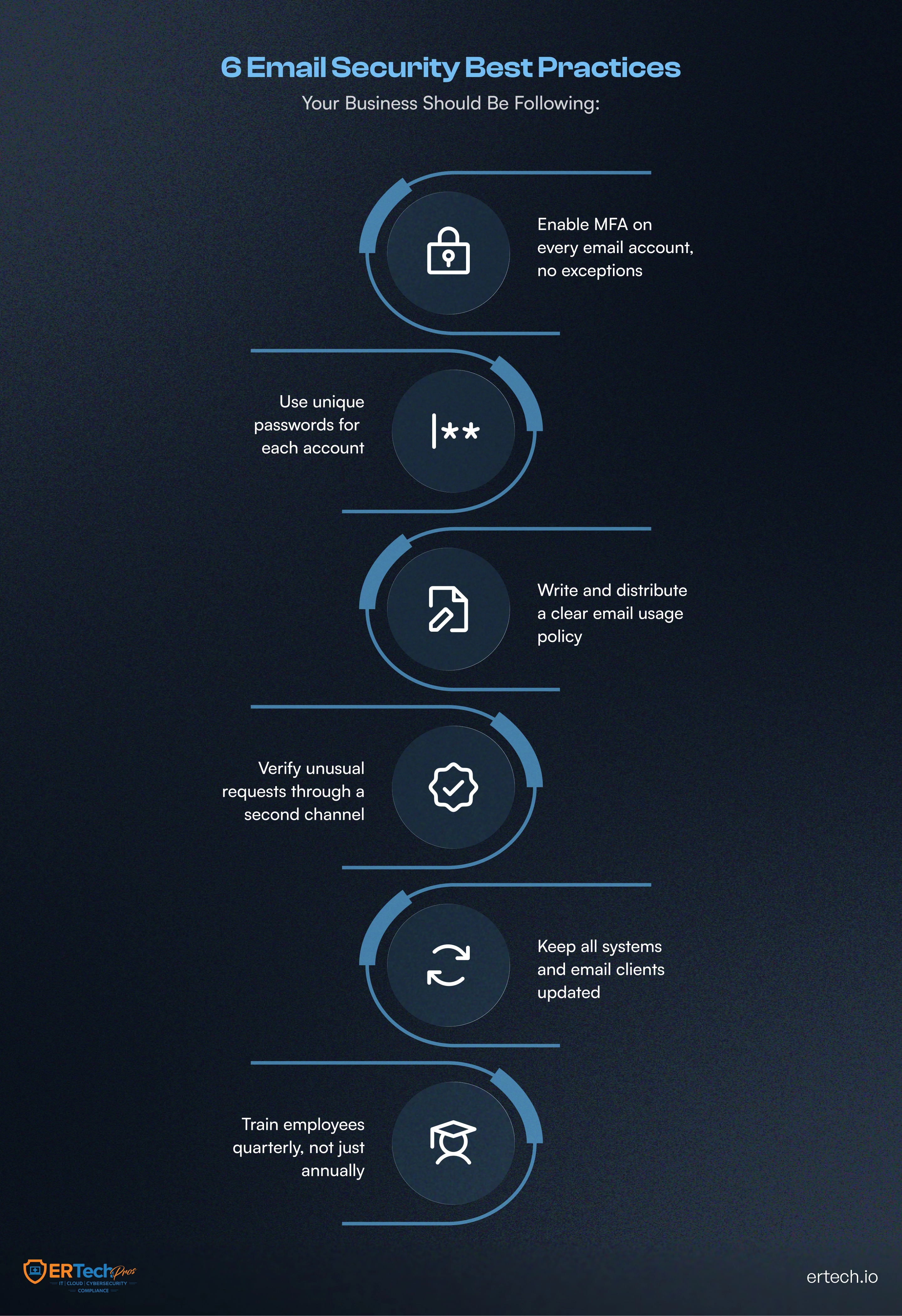
Email Security Best Practices Every Business Should Be Following
Email security best practices aren't a checklist you complete once and file away. They're a set of ongoing behaviors, policies, and technical controls that work together to significantly reduce your exposure. Here's what actually makes a difference.
Implement Multi-Factor Authentication Across All Email Accounts
If there's one email security best practice that delivers the highest return for the least complexity, it's multi-factor authentication. Even when credentials are stolen through a successful phishing attack, MFA creates a second barrier that prevents attackers from actually using them. Every email account in your organization, from the CEO to the newest hire, should have MFA enabled without exception.
Use Strong, Unique Passwords and a Password Manager
Credential reuse is one of the most common and most preventable vulnerabilities in business email security. When one account is compromised, attackers routinely test those same credentials across dozens of platforms. A password manager ensures that every account has a unique, complex password without putting that burden on individual employees to memorize them.
Establish a Clear Email Usage Policy
Your team can't follow rules that haven't been written down. A documented email security policy should cover acceptable use, guidelines for handling sensitive information, protocols for verifying unusual requests, and clear instructions for reporting suspicious messages. This doesn't need to be a legal document. It needs to be something people actually read and remember.
Verify Unusual Requests Through a Secondary Channel
Any email asking for a wire transfer, a password reset, a change in vendor payment details, or access to sensitive systems should be verified through a completely separate channel, a phone call, a direct message on a known platform, or an in-person conversation. This one habit stops a significant portion of BEC attacks cold.
Keep All Systems and Email Clients Updated
Outdated software contains known vulnerabilities that attackers actively exploit after malware is delivered via email. Consistent patching isn't glamorous work, but it closes the doors that attackers count on being left open.
Train Your Team Regularly and Realistically
Human behavior is both the biggest vulnerability and the most powerful defense in email security. Annual training isn't enough. Quarterly sessions, simulated phishing exercises, and real-time teachable moments keep your team genuinely sharp rather than passively compliant. When an employee recognizes and reports a phishing attempt, that's not just an individual win. It's organizational intelligence that can protect everyone else. ER Tech Pros designs and delivers security awareness training programs built around how your team actually works, not generic slide decks.
Email Security Tools and Solutions That Protect Your Business
Behavioral practices matter enormously, but they need technological reinforcement. The right email security tools create multiple layers of protection that work even when human attention fails.
Advanced Email Filtering and Anti-Spam Solutions
Modern email security solutions go far beyond basic spam filtering. They analyze sender reputation, message content, link destinations, and behavioral patterns to identify and quarantine suspicious emails before they reach your inbox. Effective filtering dramatically reduces the volume of threats your employees even see, which in turn reduces the chances of a successful attack.
Email Authentication Protocols: SPF, DKIM, and DMARC
These three protocols work together to verify that emails claiming to come from your domain actually originate from your domain. SPF specifies which servers are authorized to send email on your behalf. DKIM adds a cryptographic signature to outgoing messages. DMARC tells receiving servers what to do when SPF or DKIM checks fail. Together, they make it significantly harder for attackers to impersonate your domain in attacks targeting your clients, partners, and employees. Many businesses are surprised to discover these protocols aren't configured correctly, or at all, on their existing email infrastructure.
Cloud-Based Email Security
Cloud-based email security has become the standard for businesses of all sizes, and for good reason. Cloud-based platforms provide real-time threat intelligence drawn from global data, scale easily as your organization grows, and don't require on-premise hardware to maintain. They also receive continuous updates as new threats emerge, meaning your protection evolves without requiring manual intervention on your end. For businesses with remote or distributed teams, cloud-based email security ensures consistent protection regardless of where employees work.
Endpoint Protection and Email Integration
Email security doesn't stop at the inbox. If a user opens a malicious attachment on their device, endpoint protection is what contains the damage. Integrating email security with endpoint detection and response gives your IT team visibility into threats that have bypassed the first line of defense and the ability to respond before they spread.
Email Encryption for Sensitive Communications
Not every email security threat comes from outside your organization. Sensitive business communications, client data, financial information, and proprietary details should be encrypted in transit to prevent interception. Email encryption tools ensure that even if a message is intercepted, it can't be read by anyone it wasn't intended for.
Security Information and Event Management (SIEM)
For businesses managing a larger or more complex IT environment, a SIEM platform aggregates security data from across your systems, including your email infrastructure, and flags anomalies that may indicate an ongoing threat. This kind of centralized visibility is increasingly important as attacks become more sophisticated and harder to detect through any single tool.
How ER Tech Pros Approaches Email Security for Businesses
Email security isn't a product you buy once and forget about. It's an ongoing practice that requires the right combination of technology, policy, and people working together in a way that fits your organization's operations.
What makes ER Tech Pros different is that we don't walk in with a generic template. We start by understanding your business: how your team communicates, where your real vulnerabilities are, and what your employees' day-to-day habits look like. From there, we build a layered email security strategy that's specific to your environment, not a package that leaves gaps that nobody notices until it's too late.
Email Filtering and Anti-Phishing Implementation: Advanced filtering that goes well beyond spam detection, catching threats, including AI-powered phishing, before they reach your team's inbox.
Cloud-Based Email Security Deployment and Management: Real-time threat intelligence and consistent protection across every location and device, especially critical for remote and hybrid teams.
Ongoing Security Awareness Training: Ongoing, realistic training programs that give employees hands-on practice identifying threats in a consequence-free environment.
Endpoint Protection Integration: Email security that doesn't stop at the inbox, with detection and response capabilities that contain threats before they spread.
As cybersecurity trends continue to shift, so do the tactics targeting your inbox. ER Tech Pros stays current on the evolving threat landscape so your defenses move with it, not behind it.
Take a Step Towards Building an Email Security Strategy That Lasts
The businesses that get breached through email aren't necessarily the ones that ignored security entirely. Many of them had tools in place. What they often lacked was a coherent strategy where those tools, policies, and people worked together consistently.
Email security best practices only work if they're actually practiced. And your employees can only be your last line of defense if they've been genuinely prepared, not just technically trained.
The gap between having email security and having effective email security is where most breaches happen. Closing that gap requires a partner who understands both the technical landscape and the human realities of how businesses operate.
At ER Tech Pros, we help you build protection that holds up in the real world, not just on paper. If you're ready to assess where you actually stand and build something stronger, we're here for that conversation.
Protect your inbox. Protect your business.
Let us help you build layered email security that combines the right tools, trained people, and ongoing expert support to stay ahead of today's threats.
Got Questions?
We've Got Answers
Find clear answers to common questions that help guide your IT operations.
Related Content
Medusa Ransomware: What Businesses Can Learn From the Attack
How to Develop a Ransomware Recovery Plan & Prevent an Attack