How to Build a Cybersecurity Incident Response Plan for Your Business
A cyber incident can force your business to make critical decisions with limited information. Learn how to build a cybersecurity incident response plan that gives your team a defined framework for handling threats before they disrupt operations.
Modern business environments generate a constant stream of security events. Most are routine, but some can indicate compromised credentials, malicious activity, or unauthorized access. Distinguishing them takes more than a security tool alert. It requires a defined process for investigating the event, determining its significance, and deciding what action is necessary.
A cybersecurity incident response plan provides a documented process for making those decisions. It defines how security incidents are identified and investigated, who is responsible for responding, when an incident should be escalated, and what actions should be taken to limit its impact.
This preparation matters because a security incident can affect more than the system where it was first detected. An attacker may gain access through a compromised account, move to other systems, or access sensitive business information before the activity is identified. IBM's Report found that the global average cost of a data breach was $4.99 million.
An effective security incident response plan gives your team clear operating procedures before an incident occurs. The plan should reflect your actual environment, the systems your business depends on, the information it needs to protect, and the decisions your team may need to make during an investigation.
Make Incident Response Part of Your Security Strategy
Define What Qualifies as a Security Incident
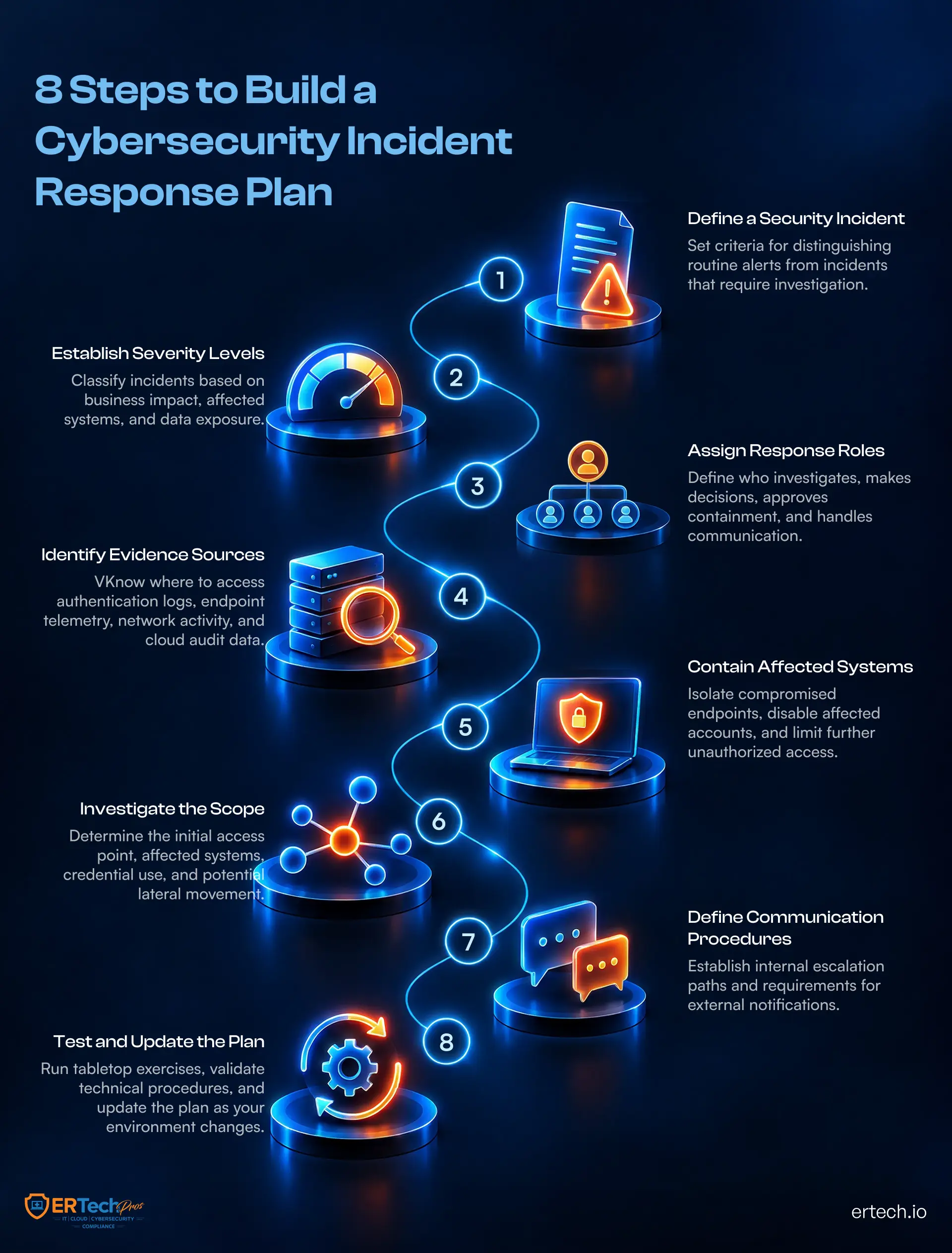
Not every security alert requires the same response. Your plan should establish clear criteria for determining when an event becomes a security incident.
These criteria can include unauthorized account access, suspicious changes to critical systems, malicious software activity, exposure of sensitive information, or behavior that indicates an attacker may have gained access to the environment.
The purpose is not to create a rigid list that covers every possible scenario. It gives responders a consistent basis for escalation when an event requires investigation or immediate action. More specific procedures can then address high-impact threats, such as a ransomware response plan for incidents involving encryption, extortion, or suspected ransomware activity.
Establish Incident Severity
Incident severity should reflect its potential impact on the organization. A compromised workstation used for routine administrative work may require a different response than a compromised account with access to financial systems or sensitive customer information.
Your plan should define severity levels and the conditions associated with each level. These criteria can determine who must be notified, how quickly the incident should be escalated, and which response actions require management approval.
Assign Responsibility Before an Incident Occurs
Incident response can involve security personnel, IT administrators, executives, legal counsel, and other stakeholders. Waiting until an incident occurs to determine who has decision-making authority can slow the response.
A security incident response plan should identify the individuals or teams responsible for key decisions. It should also establish who can authorize actions such as disabling an account, isolating a system, blocking network traffic, or taking a business-critical service offline.
Define Roles Within the Response Team
Each participant should understand their responsibilities before an incident occurs. Technical responders may be responsible for investigation and containment, while management may need to make decisions about business operations, external communication, or service disruption.
The plan should also identify who takes over when the primary responder is unavailable. Review contact information periodically so the response team doesn't rely on outdated details during an incident.
Establish Escalation Rules
Base escalation on defined conditions rather than individual judgment alone. The plan can specify when an incident requires executive involvement, legal review, notification of affected parties, or assistance from an external security provider.
Clear escalation rules matter most when an incident involves regulated information, significant operational disruption, or evidence that the attacker has accessed additional systems.
Build the Plan Around the Evidence Your Environment Can Provide
An investigation is only as effective as the information available to the response team. If relevant logs are unavailable or retained for only a short period, determining what happened can become significantly more difficult.
The plan should document which evidence sources are available across the environment and how responders can access them. This may include authentication records, endpoint telemetry, firewall activity, cloud audit logs, application records, and other security data.
Identify Critical Sources of Security Data
Start by documenting where investigators can find information about user activity, system changes, network connections, and security alerts. The goal is to understand what evidence exists before an incident occurs.
This inventory should also identify retention periods and access requirements. If responders need elevated permissions to retrieve certain logs, they should understand those requirements in advance.
Preserve Evidence During the Investigation
Response actions can alter the environment and potentially remove information that could help determine what happened. Your plan should establish procedures for preserving relevant evidence before systems are modified, reimaged, or returned to normal operation.
Evidence handling should account for the incident type, the systems involved, and any applicable legal or regulatory requirements.
Define How Compromised Systems and Accounts Will Be Contained
Containment limits an attacker's ability to continue operating within the environment. The appropriate action depends on the incident and the affected system's or account's role.
Isolate a compromised workstation from the network. A suspected compromised account may need to be disabled or have its credentials reset. A server supporting a critical business application may require a more controlled response to avoid unnecessary operational disruption.
Isolate Systems Without Losing Visibility
Containment should reduce the attacker's access while preserving, whenever possible, the information needed for the investigation. Disconnecting a system immediately may stop further activity, but it can also remove access to valuable evidence or interrupt a service that the business depends on.
The response plan should define who can authorize isolation and what information to collect before or during the process.
Address Compromised Credentials
Credentials can give an attacker access to multiple resources, especially when the same account has broad permissions. Response procedures should address account suspension, credential resets, session termination, token revocation, and, where appropriate, a review of recent account activity.
Strong access control also limits what a compromised account can reach. The investigation should determine whether the credentials were used elsewhere before the response began.
Investigate How Far the Incident Has Spread
Containing the first affected device does not necessarily contain the incident. Attackers may use compromised credentials or existing access to reach additional systems before detection.
The investigation should therefore examine activity associated with the affected account, device, applications, and network connections. This can help determine whether lateral movement occurred and whether other systems require investigation.
Determine the Initial Point of Access
Understanding how the attacker entered the environment can help identify other at-risk systems or accounts. The entry point could involve stolen credentials, an exposed service, malware, or a user interaction with a fraudulent message.
The response team should document the available evidence and avoid assuming that the first affected system was the original point of compromise.
Determine Whether Sensitive Information Was Accessed
An incident involving unauthorized access does not automatically mean that information was stolen. The investigation should establish which systems were accessed, what information the compromised account or device could access, and whether evidence shows unauthorized collection or transfer.
If the incident involves personally identifiable information (PII) or other regulated data, the organization may also need to follow specific notification and reporting requirements. The investigation should establish whether the event constitutes a data breach and what obligations may follow.
Make Communication Part of the Response Plan
Technical response is only one part of incident management. The organization may also need to communicate with employees, leadership, customers, legal counsel, regulators, or external security providers.
Define communication procedures before an incident occurs so technical responders don't have for make decisions outside their role while an investigation is underway.
Establish Internal Communication Channels
The plan should identify how incident updates will be shared and who should receive them. Handle sensitive investigation details through appropriate communication channels, especially when the incident may affect normal email or collaboration accounts.
Prepare for External Notifications
Some incidents may require communication outside the organization. The response plan should identify who evaluates notification requirements and who can communicate with customers, regulators, law enforcement, or other external parties.
The technical team should provide factual information about the incident, while the appropriate business and legal stakeholders determine what to communicate externally.
Turn the Plan Into a Practical CSIRP Checklist
A cybersecurity incident response plan (CSIRP) checklist can make the response process easier to follow during a high-pressure incident. It should support the full investigation without replacing technical judgment.
A useful checklist can include:
- Incident identification and initial documentation
- Severity assessment and escalation
- Assignment of response responsibilities
- Evidence preservation
- Account and system containment
- Investigation of affected systems
- Assessment of potential data exposure
- Internal and external communication
- Recovery authorization
- Post-incident review and documentation
The checklist should be specific enough to guide responders but flexible enough to accommodate different types of incidents.
Test and Maintain Your Incident Response Plan Before You Need It
Test a cybersecurity incident response plan under conditions that resemble an actual incident. A written procedure may seem complete until responders discover a contact is unavailable, a required log is inaccessible, or no one clearly owns an expected decision.
Tabletop exercises can walk through realistic scenarios involving phishing, credential compromise, ransomware, or unauthorized system access. These exercises allow teams to evaluate how well the plan works without disrupting production systems.
Technical testing can go further by validating whether the organization can perform the actions described in the plan. This may include isolating an endpoint, disabling a compromised account, retrieving relevant logs, restoring affected systems, or confirming that alerts reach the appropriate responders.
Testing should not be limited to a single exercise. Review the plan whenever the business environment changes. New applications, cloud services, remote access methods, security controls, employees, and business processes can all affect how an incident should be handled.
Keep contact information, escalation paths, technical procedures, and recovery dependencies accurate. Document exercise results and actual incidents, and use them to update the plan.
A response plan is most useful when it reflects the environment the team operates in today, not the systems and procedures that existed when the document was first created.
How ER Tech Pros Supports Incident Response Readiness
A strong incident response process must reflect the business's current technology environment and security requirements. ER Tech Pros provides cybersecurity services that help organizations improve visibility, assess their security posture, and prepare for potential incidents.
Our team supports businesses with security monitoring, threat detection, endpoint protection, vulnerability assessment, and other capabilities that build incident readiness. These services help organizations identify suspicious activity earlier and give responders the information they need during an investigation.
ER Tech Pros can also help review existing response procedures and identify areas where technical controls, escalation processes, documentation, or response responsibilities need improvement.
For organizations that already have a response process, this can provide an opportunity to test whether the documented procedures align with the systems and security controls currently in place.
Build a Response Plan Your Team Can Use
A cybersecurity incident response plan gives your organization a defined method for handling security incidents when the available information may still be incomplete. It establishes who is responsible for the response, how incidents are evaluated, what evidence to preserve, and how to handle affected systems and accounts.
The plan should reflect the threats most relevant to your environment and provide practical guidance for the people responsible for responding. Reviewing procedures such as a ransomware incident response checklist can also help you identify whether key actions, contacts, and escalation points are documented.
Most importantly, the plan should be tested and maintained. A response document is only useful when the people expected to follow it understand their responsibilities and the procedures have been validated against the organization's actual environment.
When a security incident occurs, the technical details may be uncertain, and the situation may change quickly. A documented response process gives your team a clear basis for decision-making as the investigation develops.
Prepare Today. Respond With Confidence Tomorrow.
With ER Tech Pros, your business can build stronger security readiness with the right visibility, controls, and expertise to respond when an incident occurs.
Got Questions?
We've Got Answers
Find clear answers to common questions that help guide your IT operations.
Related Content

IT Disaster Recovery Plan for Small Businesses: A Complete Guide

Cybersecurity Awareness Month: 14 Security Steps Every Business Should Take in 2026