Understanding Zero-Day Exploits in Healthcare
Healthcare organizations face growing cyber threats from zero-day exploits that bypass traditional security. ER Tech Pros delivers proactive cybersecurity solutions to protect patient data from day one. Schedule a FREE Consultation.
All healthcare organizations store personal, financial, and health-related data, making them the prime targets for hackers. Securing sensitive patient data is one of the biggest priorities in the healthcare space.
Despite using antivirus software and basic encryption, many healthcare organizations still fall victim to cybersecurity threats, such as zero-day exploits. These attacks take advantage of network weaknesses that developers haven’t discovered yet, bypassing ordinary security measures.
ER Tech Pros partners with healthcare organizations to implement expert, ongoing cybersecurity solutions, ensuring that systems and patient records have zero security gaps from day one.
What Is a Zero-Day Exploit?
A zero-day exploit means that cybercriminals take advantage of a zero-day vulnerability, a flaw in software or network systems that has not been discovered yet or patched. These exploits are dangerous because there’s no fix, and it gives hackers the freedom to compromise your systems.
In healthcare, these incidents target electronic health records (EHRs) and medical devices, leading to ransomware attacks that uncover sensitive patient records.
How Zero-Day Exploits Work
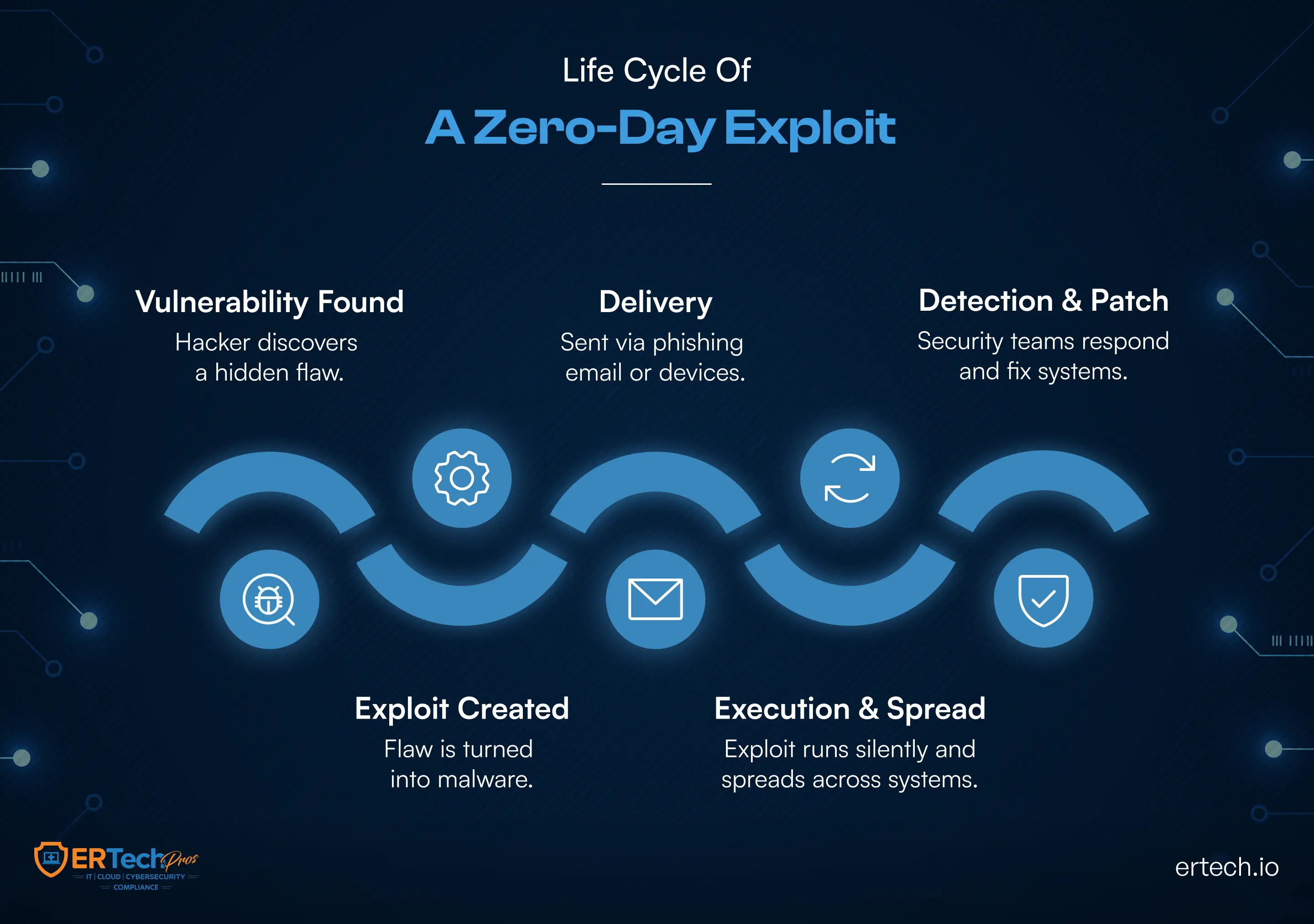
Hackers mostly follow a clear pattern when executing a zero-day attack:
- Vulnerability Discovery: Hackers find a flaw that developers are unaware of.
- Weaponization: They convert the flaw into a functional exploit, sometimes embedded in malware.
- Delivery: Exploits reach targets through phishing emails, malicious attachments, or network intrusions.
- Execution: The exploit runs quietly, granting unauthorized access.
- Impact: Data may be stolen or systems disrupted, leading to costly cybersecurity breaches.
Healthcare organizations are especially at stake because of the high value of patient data and the interconnectivity of systems. And leaving vulnerabilities unaddressed is like walking with a hole in your shoe. But, with proactive strategies, like those offered by ER Tech Pros, patch these ‘holes’ in your systems before they can be exploited.
Why the Healthcare Industry Is the Prime Target?
According to the HIPAA Journal, around 72% of healthcare organizations reported patient-care disruptions due to cyberattacks.
Healthcare is usually targeted by cybercriminals for several reasons:
- Sensitive data: Patient data contains sensitive health, financial, and personal information.
- Low detection risk: Because zero-day vulnerabilities are unknown, ordinary security tools often fail to detect them.
- Gateway to larger attacks: Many ransomware attacks begin with a zero-day exploit, escalating into full-scale system compromises.
ER Tech Pros helps healthcare organizations implement tailor-made cybersecurity solutions to prevent breaches while maintaining compliance with industry standards.
Detecting Zero-Day Exploits
Identifying zero-day attacks requires more than ordinary antivirus software. Since these threats use unknown vulnerabilities, healthcare organizations must rely on advanced detection methods.
- Continuous Network Monitoring
Real-time monitoring of network, user behavior, and system activity helps identify unusual patterns such as unauthorized access, abnormal data transfers, or suspicious login attempts. These early warning signs usually indicate a zero-day attack before major damage occurs.
- AI-Powered Threat Intelligence
Advanced threat intelligence tools use AI to identify suspicious activity across EHR systems and administrative platforms. AI analyzes trends and anomalies that typical tools miss, helping predict and identify emerging zero-day threats.
- Regular Security Audits
Ongoing security audits and vulnerability assessments help uncover misconfigurations, weak access controls, and outdated security practices that increase exposure to zero-day exploits.
- Dark Web Monitoring
Monitoring dark web marketplaces allows early detection of stolen credentials or patient data being sold online. If a breach is identified, ER Tech Pros responds immediately to contain the threat and prevent further data exposure.
By combining these layered detection strategies, healthcare organizations can identify zero-day exploits early and reduce the risk of ransomware attacks and data breaches.
Preventing Zero-Day Exploits
Preventing these sophisticated attacks involves a multi-layered approach that combines technology, processes, and people.
- Strengthen network security: Use firewalls, encryption, and intrusion detection to reduce the likelihood of unauthorized access.
- Staff training and awareness: Educate staff on phishing, suspicious links, and risky behaviors to reduce human error.
- Timely updates and patch management: Implement automated updates to close vulnerabilities as soon as patches are available. ER Tech Pros ensures this process does not disrupt any clinical workflows.
- Data leakage protection: Limit access, downloads, and sharing of sensitive patient information to reduce accidental exposure.
- Invest in cybersecurity software: Advanced antivirus, intrusion detection, and anti-ransomware solutions help protect against both known threats and emerging zero-day attacks.
By adopting these measures, healthcare organizations can substantially lower the chances of breaches and protect both patients and systems.
End Zero-Day Attacks Before They Strike
Zero-day exploits are among the most serious threats to healthcare organizations, as they can bypass standard security measures and target patient data. Therefore, organizations must adopt proactive detection, invest in ongoing staff training, implement robust network security, and upgrade to modern cybersecurity software to defend against such attacks.
ER Tech Pros partners with healthcare providers to offer end-to-end cyber protection, including real-time dark web monitoring and incident response strategies suited for clinical environments. By investing in robust solutions, healthcare organizations can lower their cybersecurity risks and continuously protect patient trust.
Got Questions?
We've Got Answers
Find clear answers to common questions that help guide your IT operations.
Related Content

IT Disaster Recovery Plan for Small Businesses: A Complete Guide

Cybersecurity Awareness Month: 14 Security Steps Every Business Should Take in 2026