
Understanding Cybersecurity Sandboxing
Cybersecurity sandboxing is a security practice that isolates untested code, files, or applications in a controlled environment before they interact with production systems. It protects the system from malware, ransomware, spyware, malicious email attachments, and phishing attempts.
It is a place where an unknown file can be opened, run, and observed without risking real data, real networks, or real users.
The core idea is containment. Sandbox security lets the file execute and reveals its true behavior. What files does it try to modify? What network connections does it attempt to make? What registry keys does it touch? It observes all of this before allowing the file to interact with production systems.
Your primary hardware and software must always be protected against various threats posed by attackers. Employing cybersecurity solutions for it usually gets the job done efficiently. ER Tech Pros offers a wide range of security solutions for your business that could protect it from potential threats.
What Is Sandboxing?
A sandbox environment is a virtualized, containerized space that closely mimics a real operating system or application environment. This fools malware, ransomware, APTs, etc. into behaving naturally while remaining fully isolated from the actual production infrastructure.
There are three types of sandboxing methods:
- Manual Sandboxing:
This type of sandboxing provides greater control, but employing it can be time- and resource-consuming since everything is handled by humans.
- Automatic Sandboxing:
Once set up, automatic sandboxing requires minimal human intervention. It enables more scalable analysis and is faster.
- Hybrid Sandboxing:
Hybrid sandboxing balances control and efficiency and combines the previously mentioned types. Automatic sandboxing provides speed, while the manual component offers greater control.
Businesses can adapt any of the above sandboxing security techniques in their open XDR system to meet the requirements.
Benefits and Use Cases of Cybersecurity Sandboxing
Sandboxes offer an environment to test threats before admitting them into the system. But beyond protection, cybersecurity sandboxes can also promote various other benefits. Let us look at some benefits of sandboxing:
- System Protection:
Sandboxing enables safe threat analysis. It ensures that malware can be observed in action without endangering real systems.
- Zero-day Detection:
Behavior-based analysis can catch threats that have no known signature yet.
- Safe Testing of Patches/Updates:
A sandbox provides a secure, isolated space for evaluating software without threatening the stability of production systems.
- Promotes Team Collaboration:
By deploying applications within a sandbox environment, organizations can invite users across diverse departments to interact with and test the software hands-on.
As zero-day threats continue to evolve in complexity and impact, organizations must establish a strong strategy to protect their data and software systems. This strategy is vital for countering advanced threats that can bypass conventional malware and email antivirus filters. Sandboxing in cybersecurity is one of the best tools to protect your business from malicious actors.
Real-World Use Cases of Sandboxing Security in Threat Detection
- Email Security: Attachments and embedded links are detonated in a sandbox before reaching a user's inbox, catching phishing payloads and malicious macros.
- Endpoint Detection and Response (EDR): Suspicious processes on employee devices are isolated and analyzed in real time.
- Web Gateway Filtering: URLs are visited in a sandboxed browser instance to check for drive-by downloads or malicious redirects.
- Software Supply Chain Security: Third-party code, libraries, or updates are sandboxed before integration into production pipelines.
- Incident Response and Forensics: Analysts detonate malware samples recovered from a breach to understand its full behavior and origin.
- Financial Services Fraud Detection: Suspicious transaction-triggering scripts or bots are isolated and studied before being blocked network-wide
How AI Sandboxing in Cybersecurity Helps Detect Advanced Threats
Modern threats are built to evade traditional defenses. Antivirus tools only catch what they already know about, but attackers constantly modify malware to slip past those signatures. In recent times, we have observed:
- The rise of polymorphic and metamorphic malware that changes its code to evade signature detection
- Fileless attacks that operate in memory and leave minimal traditional footprints
- Zero-day exploits with no existing detection rules
- Increasingly targeted, sophisticated attacks (APTs) designed to blend into normal system behavior
If we eliminate sandboxing in cybersecurity, businesses will have no way to detect these threats early and will be left reacting only after the threats have been deployed. AI in cybersecurity ensures that our defense systems remain up to date and ready to fight as threats grow stronger.
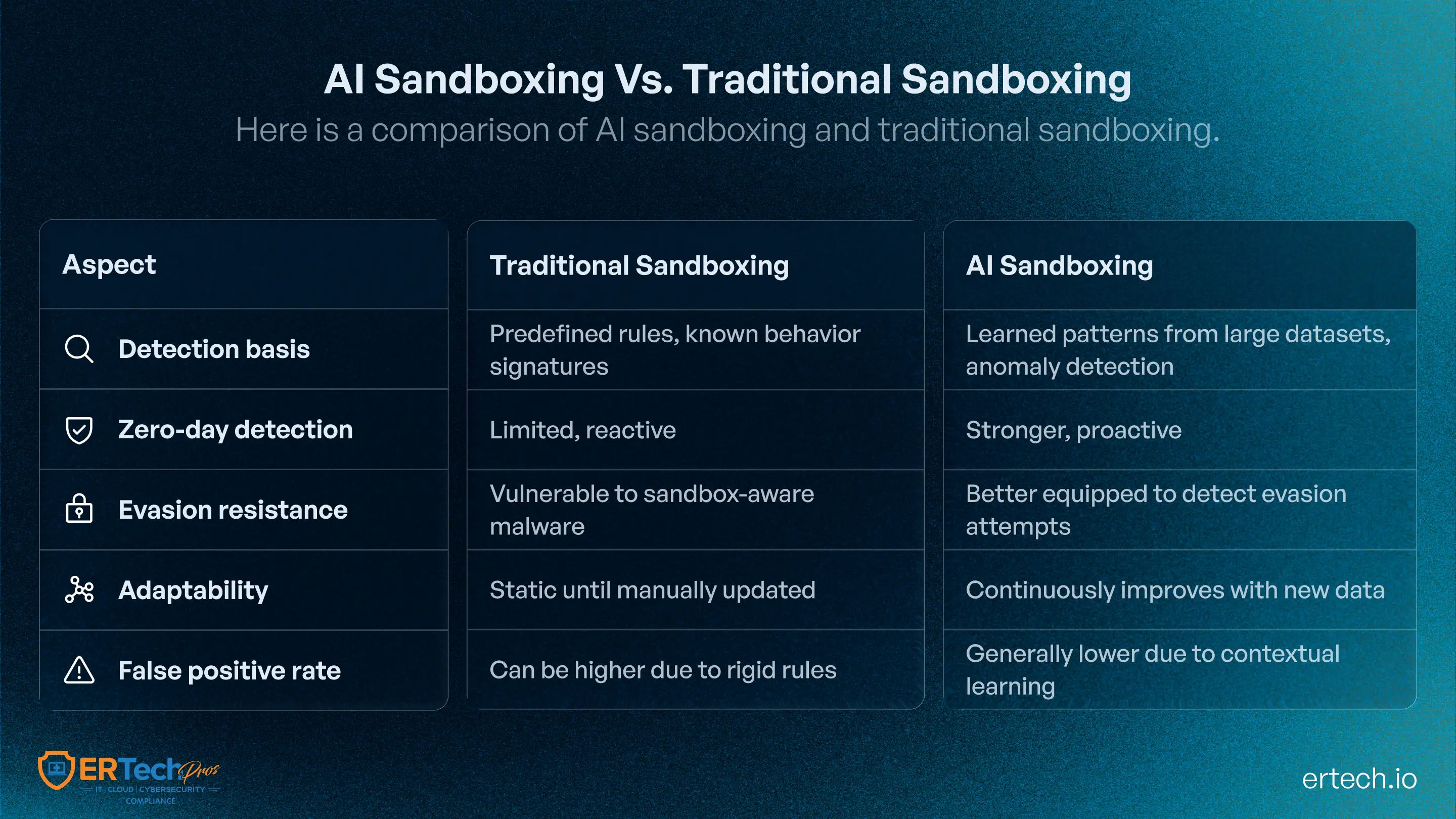
Traditional sandboxes rely on predefined rules and human-reviewed behavioral indicators. AI-powered sandboxing adds a layer of machine learning that can:
- Identify subtle behavioral patterns across thousands of samples that a human analyst would miss.
- Detect evasion techniques. Many modern malware strains can detect when they're in a sandbox and simply refuse to execute maliciously. AI models are trained to recognize these evasion attempts themselves.
- Correlate behavior across multiple stages of an attack chain, rather than looking at isolated actions.
- Continuously learn from new samples, improving detection accuracy over time without manual rule updates.
AI models are trained on large datasets of both benign and malicious behavior. They can flag anomalies that deviate even slightly from normal behavior and can catch threats designed to look mundane.
Sandboxing Architecture and Deployment Models
Sandboxing solutions are generally deployed in a few core architectures:
- On-site Sandboxing:
Analysis of their data stays within the company infrastructure. On-site sandboxing is preferred when the data is highly sensitive, such as in banks, government organizations, and hospitals.
- Cloud-based Sandboxing:
Suspicious files are uploaded to a cloud service for detonation and analysis, providing scalability and reducing the load on local infrastructure. This is increasingly the dominant model due to elasticity and centralized threat intelligence sharing.
- Hybrid Deployments:
Combine on-premises and cloud sandboxing. Local sandboxes handle fast, low-risk triage, while cloud sandboxes take on deeper, resource-intensive analysis.
Traditional sandboxing remains valuable and is often less complex to deploy and audit. AI sandboxing isn't a replacement so much as an evolution. Most mature security stacks now combine both, using traditional rule-based detonation as a first pass and AI models for deeper behavioral correlation.
AI-Enhanced Sandboxing in Cybersecurity for Advanced Threat Protection
The future of sandboxing is increasingly tied to AI-driven automation across the full detection lifecycle. As attackers adopt AI themselves to generate more evasive and adaptive malware, AI-enhanced sandboxing is becoming necessary since they offer features like:
- Predictive threat modeling: AI systems can anticipate likely attacker next steps based on early-stage sandbox behavior, enabling faster containment
- Cross-organizational threat intelligence: Cloud-based AI sandboxes can pool anonymized behavioral data across customers, improving detection for everyone using the platform
- Adaptive evasion countermeasures: As malware authors design new sandbox-detection techniques, AI models can be retrained faster than manual rule-writing allows
- Natural language threat summaries: Some modern platforms use generative AI to translate complex sandbox telemetry into plain-language incident summaries for faster human decision-making
Incorporating AI-enhanced sandboxing in your business’s cybersecurity strategy is an essential counterbalance to keep defensive capabilities in step with offensive innovation.
Enhance Your Cybersecurity Infrastructure
By adopting cybersecurity sandboxing solutions, organizations can detect suspicious behavior earlier, accelerate incident investigations, and mitigate threats before they cause major operational disruptions. ER Tech Pros offers comprehensive cybersecurity services for the benefit of your business. Investing in sandboxing security technology helps businesses strengthen endpoint security, improve incident response capabilities, and gain greater control over distributed environments.
Stay on Top of Your System's Security with ER Tech Pros
Take proactive steps to secure your business instead of waiting to react to threats.
